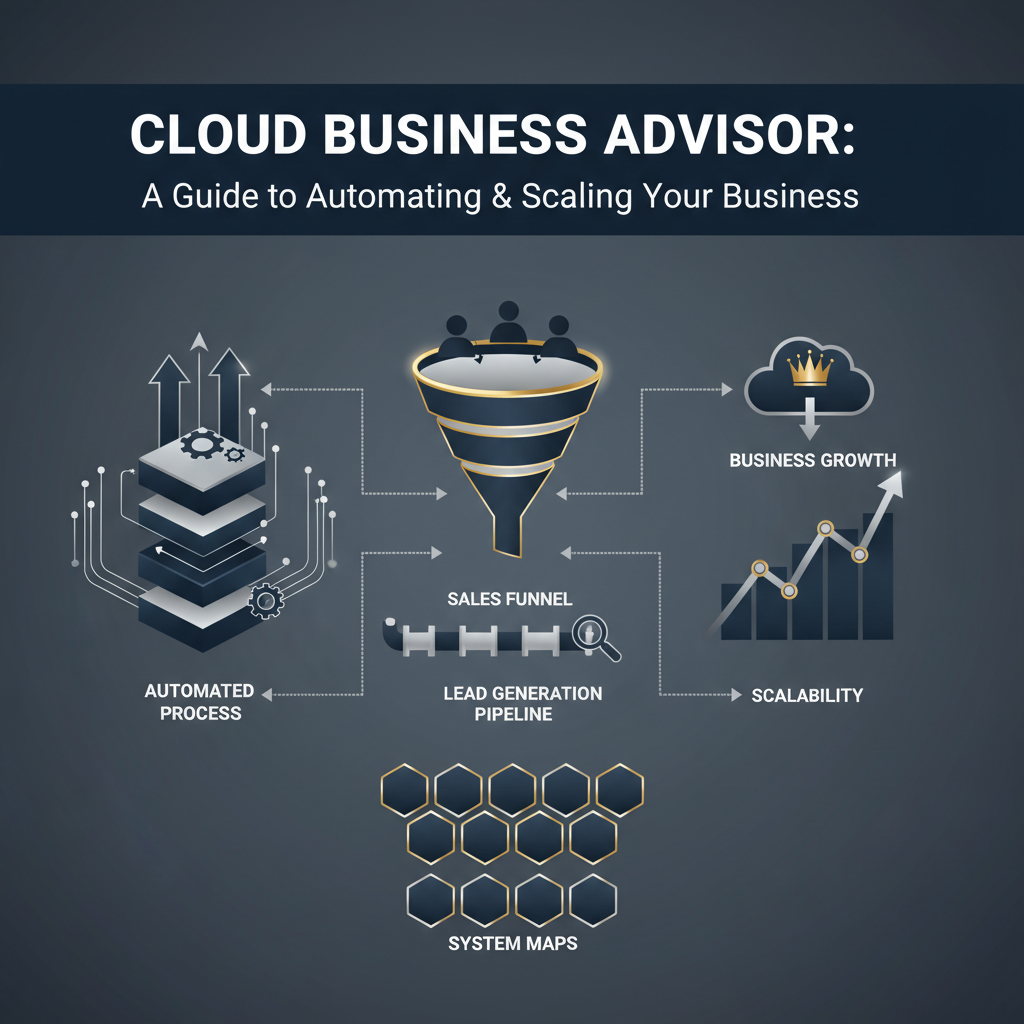
A cloud business advisor helps companies use cloud-based technology to streamline operations, automate workflows, and accelerate growth. For entrepreneurs and small business owners, this involves adopting integrated online business solutions to improve efficiency, build automated sales funnels, and establish a scalable, professional online presence without requiring a large IT department.
Growing your business online is tough. Many entrepreneurs feel overwhelmed by marketing and operations. It’s frustrating to rely on manual work that leads to inconsistent results. This can make it hard to earn steady revenue and build scalable business processes. But what if you could adopt a new mindset? Thinking like a cloud business advisor can transform your operations from chaotic to clear and make them far more efficient.
Adopting a cloud business advisor perspective doesn’t mean becoming an IT specialist. It’s about using modern online tools to automate your work without sacrificing quality. This helps you scale your business smarter and faster. Imagine getting consistent leads through automated sales funnels. You could create a professional online presence with expert branding and website creation, and manage your digital footprint with confidence. This method moves you beyond guesswork. You can use proven automation strategies to achieve real significant small business growth.
This guide will teach you to act as your own strategic cloud business advisor. You’ll learn how to look professional and trustworthy online while making your operations more efficient. We’ll show you how to find automation opportunities, choose the right online platforms, and use key cloud tools for every part of your business—from lead generation strategies to reputation management. Let’s explore what a cloud business advisor does and why this mindset is so important for small businesses today.
What is a Cloud Business Advisor?
Moving Beyond IT: The Strategic Role for Small Businesses
A “Cloud Business Advisor” does more than typical IT support. For small business owners, this role is deeply strategic. It uses cloud tools to drive real growth and make your work easier. This advisor helps you get past basic tech problems.
Instead, a cloud business advisor helps you build a strong online presence. They specialize in automating key business processes. Their main goal is to help you earn more money with less effort. Think of them as your guide to success online. They are vital if you struggle to grow your business on the web.
The strategic role of a cloud business advisor includes:
Identifying Growth Opportunities: Finding areas where cloud tools can create new income or reach more customers.
Streamlining Operations: Looking at your current workflows to add business process automation, which saves time and money.
Enhancing Online Presence: Making sure your brand and website look professional to attract the right clients.
Developing Automation Strategies: Building automatic sales funnels and lead-finding plans that work 24/7.
This approach changes how small businesses work. It shifts you from just fixing problems to planning for growth.
How This Role Drives Business Process Automation and Growth
A cloud business advisor is key to moving your business forward. They do this by using proven methods for business process automation and growth. The goal is to switch from manual, disconnected tasks to smooth, automated systems.
Here’s how this role gets great results:
Automating Repetitive Tasks: A cloud advisor finds tasks that can be automated, like email marketing or scheduling. This saves you a lot of time. It lets you focus on the most important work. Many businesses report significant time savings after implementing automation [1].
Implementing Automated Sales Funnels: They build sales funnels that work automatically. These systems guide people from being interested to becoming loyal customers. This creates a reliable way to get new clients and generate leads.
Strengthening Online Presence: Their expert help ensures your brand and website look professional and effective. This builds trust with customers online. They also help manage your online reputation so good reviews get noticed.
Optimizing Digital Marketing Systems: Advisors connect your social media and content plans. They set up systems to follow up with leads automatically. This makes your small business marketing services work together well. You’ll feel less overwhelmed by marketing tasks.
Enabling Scalable Business Processes: By setting up strong marketing and work systems, a business can grow without a big rise in costs. This means you can scale up easily. You can grow without hiring many different agencies for help.
In short, a cloud business advisor connects technology to your business goals. They help you automate tasks while keeping quality high. They provide the expert advice needed for steady growth. This ensures your business runs well as it scales smarter and faster.
Why Does Your Business Need a Cloud-First Strategy?
Automate Repetitive Tasks to Save Time and Reduce Costs
As a business owner, your time is your most valuable asset. Manual tasks can take up hours of your day. This includes posting on social media, sending emails, or handling customer questions. Using the cloud is the first step to powerful business automation.
When you move to the cloud, you can set up automation to handle daily work. This frees your team from boring tasks. It lets you focus on growing your business and serving customers. Studies show automation can make businesses much more productive. Some report a 40% boost in efficiency [2].
Here’s how a cloud-first approach changes your daily work:
Streamlined Workflows: Automate tasks like data entry, report creation, and inventory updates.
Reduced Manual Errors: Let systems handle routine tasks to minimize human error.
Smarter Resource Use: Your team can spend more time on important, high-value work.
Lower Operational Costs: Automation cuts down on manual work, which directly saves you money.
Automated-Biz offers online business tools to solve these problems. Our platform helps you go from feeling overwhelmed by marketing and daily tasks to having a smooth, efficient workflow. This change saves you time and lowers your overall costs.
Scale Operations Efficiently Without Increasing Headcount
Growing a small business can be hard. It often means hiring more people or spending a lot on new equipment. A cloud-first strategy changes that. It gives you the flexibility you need to grow your business in a smart way.
Cloud systems let you scale up or down based on demand. You only pay for what you use. This flexibility is key for businesses with busy seasons or fast growth. You can handle more website traffic, data, and customers without the high costs of older growth methods [3].
Benefits of cloud-based scaling include:
Agile Resource Management: Quickly adjust your computing power and storage to meet your needs.
Global Reach: Easily serve customers anywhere without a physical office.
Cost-Effective Expansion: Avoid big spending on hardware and extra IT staff.
Consistent Performance: Keep your services running well, even during your busiest times.
With Automated-Biz, you get a partner to help your business grow steadily. Our automation platform ensures that as your business gets bigger, your systems grow with you. You will not need to keep hiring more people to handle the extra work. We empower you to grow smarter and faster.
Enhance Your Online Presence and Reputation
In today’s digital world, a professional online presence is a must-have. Customers expect to find you easily and see a brand they can trust. A cloud-first strategy gives you a solid, secure base to build and maintain your online brand.
Hosting your website, apps, and marketing tools in the cloud is faster and more reliable. It makes sure your website is quick, safe, and always online for your visitors. This helps you look more professional and trustworthy to potential clients.
Elevate your online presence with:
Reliable Website Hosting: Enjoy a fast-loading website that is always online for visitors.
Enhanced Security: Cloud providers offer strong security to protect your data and customers.
Consistent Branding: Manage all your digital files from one central, easy-to-reach place.
Effective Online Reputation Management: Use tools to monitor reviews and respond to feedback quickly.
Automated-Biz knows how important a strong online brand is. We offer professional branding, custom logos, and expert website design and hosting. Our platform also includes tools for social media and online reputation. These services ensure your online presence is professional, consistent, and always improving.
Create Automated Sales Funnels for Consistent Lead Generation
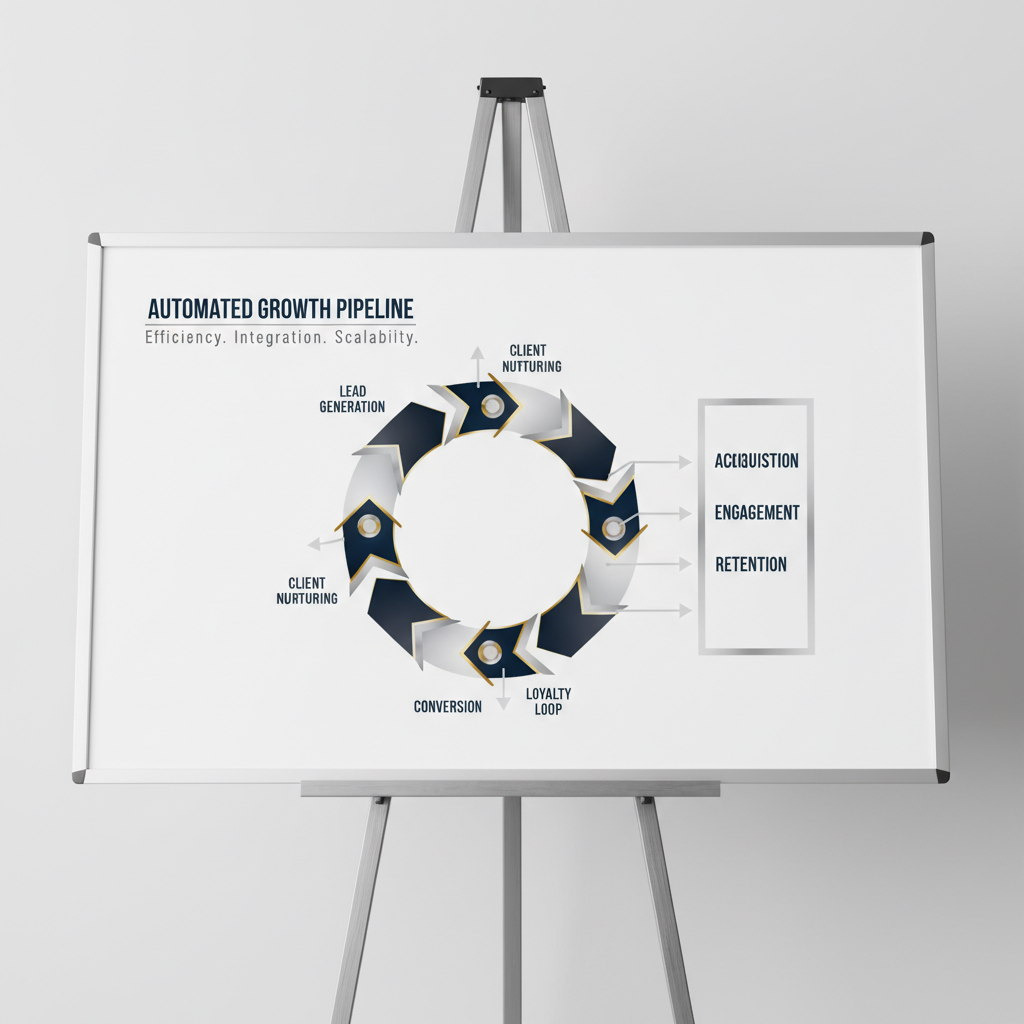
Getting new leads is key to growing any business. Many owners struggle to find a steady way to get new clients. A cloud-first strategy lets you build smart, automated sales funnels. These funnels work 24/7 to attract new leads and turn them into loyal customers.
By using cloud-based marketing tools, you can create smooth ways to get leads. Potential customers enter your funnel and get helpful content that guides them to a sale. This all happens automatically. Businesses that use marketing automation often see a big increase in qualified leads [4].
Key advantages of cloud-based automated sales funnels:
24/7 Lead Nurturing: Send personalized content to potential clients at any time.
Predictable Client Acquisition: Set up a reliable system for getting new business.
Efficient Follow-Up: Automate emails and reminders to keep leads interested.
Data-Driven Optimization: Track results to improve your funnels and get more sales.
Automated-Biz specializes in creating powerful digital marketing systems. Our platform includes automated sales funnels and tools to nurture leads. We help you go from getting leads unpredictably to having a steady stream of new clients. Our expert-guided solutions are designed to deliver real results and boost your revenue.
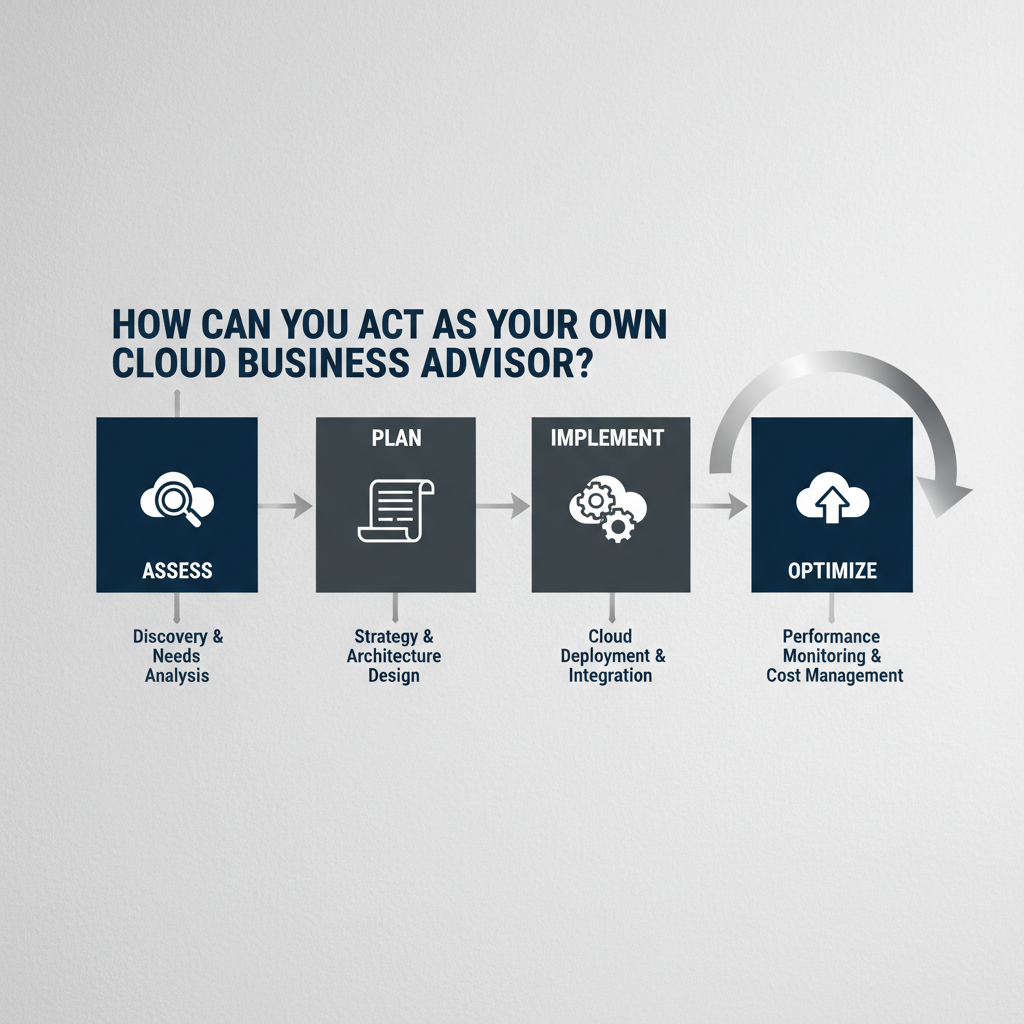
How Can You Act as Your Own Cloud Business Advisor?
Professional, action-oriented infographic for ‘How Can You Act as Your Own Cloud Business Advisor?’. Vector-based, step-by-step process flow diagram using clean geometric shapes. The diagram should illustrate a multi-stage framework or hierarchical system, starting with ‘Assess’, moving through ‘Plan’, ‘Implement’, and ‘Optimize’, symbolized by interconnected, distinct blocks or pillars. Each block should feature a relevant abstract icon (e.g., a magnifying glass for assess, a blueprint for plan, a gear for implement, an upward arrow for optimize). Employ a deep navy, charcoal, and white color scheme, with silver or gold accents for connectors or directional markers. Maintain an executive-level aesthetic with structured grouping and negative space for implied labels. Focus on clear, actionable guidance and proven workflows. No humans, no cartoons.
Step 1: Audit Your Current Workflows for Automation Opportunities
To become your own cloud business advisor, start by looking at how you work now. Many entrepreneurs feel overwhelmed with marketing and operations tasks. A good audit shows where you lose time and money. This first step is key for business process automation.
Review every task you and your team do regularly. Look for repetitive, manual processes. These are perfect for business automation.
Consider the following areas for your workflow audit:
Client Onboarding: How do new clients move from prospect to active client?
Lead Management: What happens from the first contact to a qualified lead?
Marketing Activities: Are your social media posts, emails, and content distribution manual?
Sales Follow-Ups: Do you manually send reminders and proposals?
Customer Support: Are common questions answered repeatedly without a system?
Reporting: How do you track your results?
Find your slowdowns and wasted effort. Your goal is to find tasks you can make standard and then automate. This smart approach creates the base for streamlined operations and significant time savings.
Step 2: Select an Integrated Platform for Your Online Business Solutions
After your audit, the next step is choosing the right tools. Using many different tools often creates more work. True efficiency comes from a single, connected platform. This brings all your online business solutions together.
An all-in-one platform is key for small business growth. It simplifies your technology. It also makes sure data flows smoothly between tools. Look for a platform that includes these key services:
Branding & Website Creation: Professional design tools and hosting.
Marketing Automation: Email, social media, and ad management.
Sales Funnel Management: Tools to build and optimize sales processes.
CRM & Lead Nurturing: Systems for managing client relationships and follow-ups.
Analytics: Centralized reporting for informed decision-making.
Automated-Biz is designed for this exact need. We offer a complete solution for owners who want to automate workflows without losing quality. Our platform gives you expert-level tools. It moves you from separate tools to one system. This speeds up your move from manual work to automated, streamlined operations.
Step 3: Implement Automated Lead Nurturing and Client Management
A steady flow of leads and strong client relationships are key to growing your business. Once you have your platform, focus on automated lead nurturing and smart client management. This helps you generate consistent leads.
An automated sales funnel guides potential customers on their path to buying. It uses scheduled messages to stay in touch. This frees your time while keeping leads engaged. For instance, businesses using marketing automation see a 14.5% increase in sales productivity [5].
Key components for this step include:
Lead Capture Forms: Integrate these on your website and landing pages.
Email Sequences: Develop tailored content for different lead segments.
CRM System: Track interactions and client data automatically.
Automated Follow-ups: Schedule reminders for proposals or check-ins.
Client Segmentation: Group clients for personalized communication.
Automated-Biz gives you powerful tools for lead generation strategies and client management. We help you build effective sales funnels. Our platform turns a random lead flow into predictable client acquisition and repeat sales. You can build relationships well, making sure no lead gets lost.
Step 4: Use Cloud Tools for Branding and Website Creation
Your online presence is your digital storefront. To appear professional and trustworthy online, you need strong branding and a high-quality website. Cloud tools make this easy to get and to manage. You no longer need deep tech skills.
Good branding and website creation are a must for any serious business. A well-designed site builds trust. It also serves as the hub for your automated sales funnels.
Focus on these elements for a powerful online presence:
Custom Logo & Brand Identity: Show your business values visually.
Responsive Website Design: Ensure it looks great on all devices.
Secure Hosting: Keep your site fast and protected.
Clear Calls to Action: Guide visitors towards desired outcomes.
SEO Optimization: Improve visibility in search results.
Automated-Biz offers expert branding and website creation services. We connect these to your main automation plan. This means your website is not just a brochure. It’s an active part of your digital marketing systems. We guide you from DIY guesswork to expert-guided business automation. This gives you a professional website that performs well.
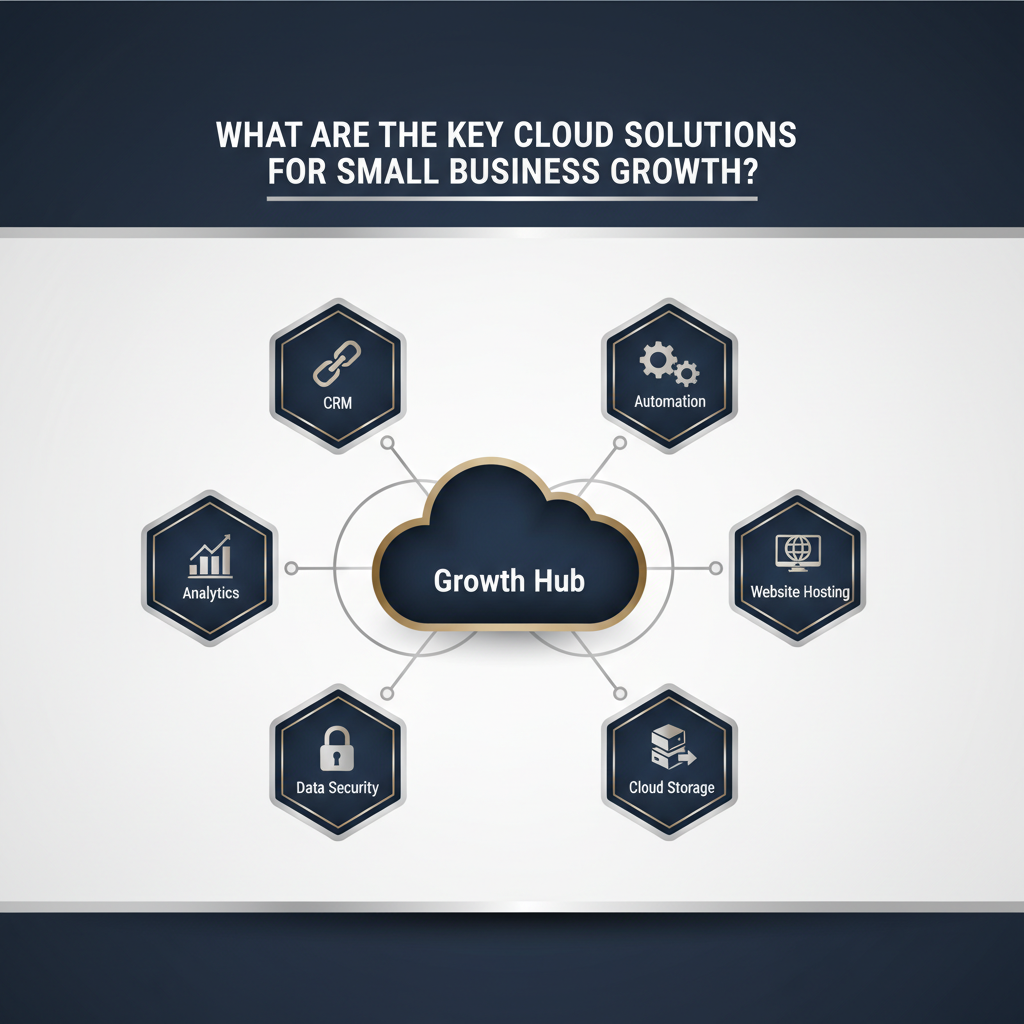
What Are the Key Cloud Solutions for Small Business Growth?
Premium, results-driven infographic for ‘What Are the Key Cloud Solutions for Small Business Growth?’. Minimalist, vector-based illustration depicting a central, abstract ‘growth hub’ (e.g., a stylized cloud or core business icon) from which multiple interconnected pathways extend to various cloud solution modules. Each module should be represented by a clean geometric shape (e.g., hexagon, rectangle) and contain a distinct abstract icon symbolizing a cloud solution category, such as ‘CRM’ (linked chain), ‘Automation’ (gears), ‘Analytics’ (bar chart), ‘Website Hosting’ (globe/monitor). Use a deep navy, white, and charcoal color palette with subtle silver or gold metallic accents to highlight connections and central focus. The layout should have clear visual hierarchy and structured grouping, with ample negative space. No humans, no cartoons, focus on conceptual visuals and premium branding.
All-in-One Business Automation Platforms
As cloud business advisors, we know all-in-one platforms are key for small business growth. These tools bring all your important tasks into one place. You won’t need to switch between different apps anymore.
Do marketing and daily tasks feel overwhelming? Is it hard to grow your business online? An all-in-one platform is the simple answer. It changes messy, manual work into smooth, automated systems.
Key benefits include:
Time-Saving Automation: Automate repeat tasks like emails, social media posts, and client follow-ups. This saves you valuable time.
Streamlined Operations: Manage your brand, website, sales, and clients from one dashboard. This makes work simpler and faster.
Consistent Lead Generation: Set up automated funnels to capture and nurture leads. This gives you a steady way to find new clients.
Scalable Business Processes: Build systems that help your business grow. You can expand without hiring more people.
Research shows 91% of small businesses use automation to compete with bigger companies [6]. Automated-Biz offers a complete, full-service platform. It combines branding, websites, sales funnels, and client management. This strong solution helps you earn more money with less work.
Social Media Automation and Management
A professional social media presence is key for online growth. But managing many platforms is hard. Social media automation and management tools solve this problem.
If marketing is overwhelming or you need a steady stream of leads, automation is key. It helps you stay active and engaging online. This keeps your brand fresh in your audience’s mind.
These cloud solutions offer great results:
Consistent Online Presence: Schedule posts for all your channels. This keeps you active without constant work.
Increased Brand Visibility: Share content at the best times for more reach. Over 70% of small businesses use social media to find new customers [7].
Efficient Content Planning: Plan your content with a calendar. Reuse old content to reach more people.
Audience Engagement: Track conversations and reply quickly to build a community. Tools help you connect with your audience.
Automated-Biz offers full social media management and content planning. We manage both your free and paid social media plans. This helps your brand connect with your audience and turn followers into loyal clients.
Online Reputation Management Software
Your online reputation is your most important asset. Today, customers trust online reviews and testimonials. Online reputation management (ORM) software is key to building trust.
Want to look professional and trustworthy online? Need to build your credibility? ORM tools let you take control of your online image. They help turn happy clients into your best supporters.
The benefits of ORM are clear:
Enhanced Trust: Collect and show positive reviews. This makes new customers feel confident.
Proactive Issue Resolution: Track mentions and reviews online. Reply to bad feedback quickly and professionally.
Increased Conversion Rates: 89% of people read reviews before they buy [8]. Good reviews lead to more sales.
Improved Online Credibility: Create a positive story about your business. This builds a strong professional image online.
Automated-Biz adds powerful reputation and review tools to its platform. We help you ask for feedback, manage testimonials, and improve your online trust. This is key for getting repeat customers and growing your business.
Integrated Website and Sales Funnel Builders
Your website is your online store. A tool that builds both your site and sales funnels is key. It helps you look professional and get new leads. It’s more than just a simple online brochure.
Is it hard to find new leads? Want a professional website without hiring many experts? These tools simplify how you find new clients. They put branding, web design, and sales plans into one simple system.
Key outcomes for your business include:
Professional Online Presence: Build a beautiful website that works on any device. It will match your brand and logo.
Automated Sales Funnels: Create landing pages and sales funnels that work. They guide visitors from just looking to buying.
Predictable Client Acquisition: Use forms and buttons to capture leads. This brings in a steady flow of new customers.
Maximized Revenue: Improve every step of the customer’s journey. Companies good at nurturing leads get 50% more sales-ready leads for 33% less cost [9].
Automated-Biz offers expert website design and hosting. We also build smart, automated sales funnels. This all-in-one approach makes sure your website isn’t just nice to look at. It also helps you grow your business and make more money.
Frequently Asked Questions
What is a Cloud Advisor?
A Cloud Advisor is more than an IT specialist. They are a strategic guide. They help businesses use cloud technology to meet their goals. For small business owners, this can change how you work.
At Automated-Biz, we act as your advisor. Our platform gives you the tools and help you need to be your own Cloud Business Advisor. We help you simplify tasks, automate marketing, and grow your business wisely.
A Cloud Advisor adds value in these key areas:
Workflow Automation: Automating daily tasks saves a lot of time and prevents mistakes.
Operational Efficiency: Bringing all your online business tools together into one simple system.
Online Reputation Management: Creating plans to build and protect your business’s good name.
Ultimately, a Cloud Advisor helps you run your business more efficiently. You can achieve real results. This helps you move from unpredictable outcomes to steady, planned growth.
What is a cloud business advisor certification?
A cloud business advisor certification shows someone knows how to use cloud technology for real business results. It is not just about technical details. These certifications focus on strategy. They teach professionals how to advise companies on using the cloud well.
Key topics usually include:
How to manage cloud costs and save money.
Making the business case for moving to the cloud.
Rules, risks, and safety in the cloud.
Finding new business ideas using the cloud.
Knowing the different cloud services (IaaS, PaaS, SaaS) and how they help a business.
Planning for automation and a move to digital.
Certifications differ, but they all teach a person how to check a business’s needs. They learn to suggest the right cloud plan and explain its value. For a small business owner, knowing this helps you make smart choices. Automated-Biz puts this same advice into our platform. We give you step-by-step help and expert support. You get the benefits of a certified advisor without needing the certificate yourself.
Our goal is to help you automate tasks, build your online presence, and grow with less work. We turn complex cloud plans into simple, effective solutions for your business.
How is a cloud advisor different from an AWS or OCI specialist?
A Cloud Advisor is different from a specialist for a platform like AWS (Amazon Web Services) or OCI (Oracle Cloud Infrastructure). The main difference is their focus. Both roles are important, but they help your business in different ways.
Cloud Advisor: Strategic & Holistic
A Cloud Advisor thinks about the big picture and your business strategy. They focus on business results and the value of using the cloud. The specific brand doesn’t matter. Their skills include:
Business Strategy: Matching cloud tools to your main business goals, like growing sales or working more efficiently.
Vendor Agnostic Recommendations: Advising on the best cloud platforms (like AWS, OCI, or Azure) based only on what your business needs.
Integrated Solutions: Focusing on how different cloud tools work together. They help create complete digital marketing systems[14], automated sales funnels, and client management.
Problem-Solving: Fixing common problems. For example, if you struggle to grow online or feel overwhelmed by marketing, they give you an expert plan for automation.
AWS/OCI Specialist: Technical & Platform-Specific
An AWS or OCI specialist is a technical expert. They know one specific cloud platform very well. Their focus is on the “how-to” for that single system:
Technical Implementation: Building and running your apps and systems on AWS or OCI.
Platform Optimization: Making sure services on their platform run well, are secure, and save you money.
Hands-on Configuration: Using technical tools to build and look after your cloud setup.
Vendor Specificity: They are experts in just one cloud provider. This makes them great for getting the technical work done.
Automated-Biz closes this gap for small business owners. We act as your Cloud Business Advisor. We bring the best cloud tools and services together on one easy platform. You get help with branding, websites, and social media, all without hiring different specialists. We give you expert advice and simple solutions to help you grow smarter and faster.
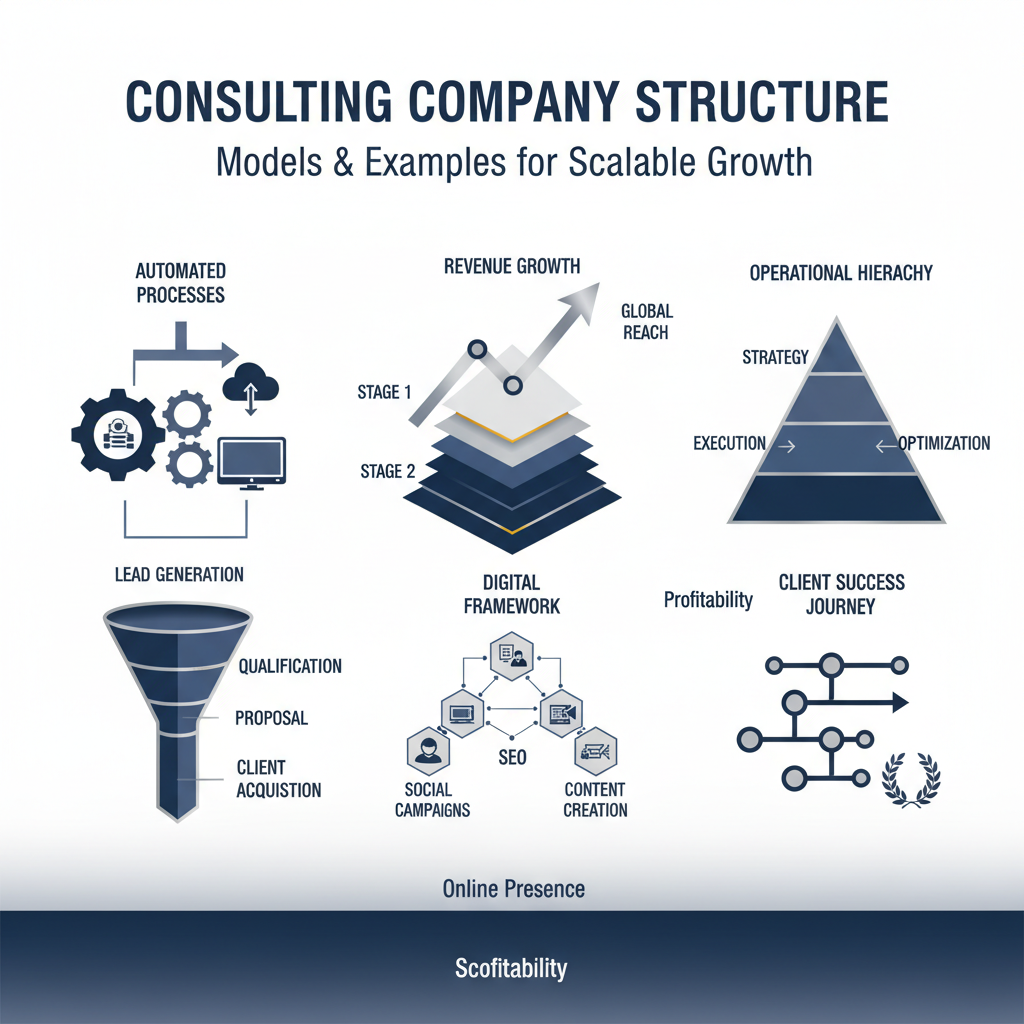
A consulting company structure defines its legal and operational framework, dictating how it’s taxed, who is liable, and how it’s managed. Common structures range from simple Sole Proprietorships for individual consultants to more complex LLCs and Corporations for larger firms seeking liability protection. The best structure depends entirely on the firm’s size, number of partners, and long-term growth objectives.
As a consultant, your expertise is your most valuable asset. But as your business grows, so do the challenges. You might find yourself overwhelmed by marketing and operations tasks, struggling to expand online, and realizing that unplanned growth causes problems instead of success. A strong business foundation isn’t just nice to have—it’s essential for turning your passion into a scalable company.
The solution is to plan your company structure carefully. This goes beyond legal paperwork. It means picking a business model that fits your goals, services, and future plans. This guide offers simple advice and real examples to help you find the right structure for your consulting business. We’ll cover options from sole proprietorships to corporations and show how the right choice leads to growth, credibility, and efficiency.
Choosing the right structure helps you automate tasks, find new clients, and look professional from day one. By organizing your business well, you’ll have more time to focus on what you do best: getting great results for your clients. Let’s explore the first steps to building a consulting firm that can succeed and grow for years to come.
Why is Your Consulting Company Structure a Critical First Step?
Starting a consulting business takes more than just expertise. You need a solid foundation. Your consulting company structure is that crucial first step. It shapes everything you do, from your legal standing and taxes to your potential for small business growth.
Many new consultants skip this step to focus on finding clients. But the wrong business structure can create big problems later. You could face legal risks or pay more in taxes than you need to. It also makes growing your business much harder, leaving you overwhelmed with marketing and operations tasks.
Choosing the right structure has clear benefits:
Legal Protection: It protects your personal assets from lawsuits or business debts. This is a key reason why small businesses with a formal legal structure tend to last longer [1].
Tax Efficiency: Different structures have different tax benefits. Choosing the right one can lower your taxes and increase your profit.
Operational Clarity: A good structure clarifies who does what. It creates a clear plan for how your business runs, which is key for using business process automation.
Scalability: The right structure makes it easier to grow. You can hire employees and bring on partners confidently, setting you up for long-term small business growth.
Professional Credibility: A formal structure shows clients and investors you’re serious. It helps you appear professional and trustworthy online and supports your branding and website creation efforts.
Think of your company structure as the foundation for your goals. It’s the framework for building a professional online presence, adding automated sales funnels, and using effective lead generation strategies. Without the right structure, automation tools won’t work as well, and you might struggle to grow your business online. A smart structure helps you switch from manual work to smooth, automated systems. You can go from getting inconsistent leads to finding new clients reliably. Automated-Biz provides the online business solutions to help you succeed. We guide you from DIY guesswork to expert-led business automation.
What Are the Most Common Consulting Company Structures?
A minimalist, vector-based infographic illustrating three distinct consulting company structures (e.g., flat, hierarchical, matrix) side-by-side. Each structure is represented by clean, geometric shapes and connecting lines in deep navy, charcoal, and white, with subtle silver or gold accents. The layout maintains ample negative space, clear visual hierarchy, and a professional, analytical aesthetic, suitable for executive-level understanding. No text other than implied labels via negative space.
Sole Proprietorship: The Solo Consultant’s Choice
Most consultants start out as a sole proprietorship because it’s the simplest business structure. Legally, you and your business are the same entity. It requires very little paperwork to get started and gives you direct control over everything.
Key Characteristics and Considerations:
Simplicity: Easy to set up and run, with fewer regulations to follow.
Full Control: You make all the decisions, which helps you adapt and change direction quickly.
Direct Profit: All profits go directly to you and are taxed as your personal income.
Unlimited Liability: This is a major drawback. Your personal assets, like your home or car, are not separate from business debts. This puts you at significant personal risk [2].
Limited Scalability: Growing the business can be difficult because it often depends entirely on your personal time.
For solopreneurs and new consultants, a sole proprietorship is a fast way to begin. However, this structure can leave you unprotected and make it harder to grow your business online. Automated-Biz helps solo consultants build a professional online presence with services like branding and website creation. You can also use tools like automated sales funnels and lead generation strategies. These allow you to scale your business smartly, even when you work alone. You can earn more with less effort, replacing guesswork with expert-guided business automation.
Partnership: Collaborating for Growth
A partnership is a business owned by two or more people who share responsibilities and profits. This structure is great when partners have different skills that work well together. It also lets you pool your resources and knowledge.
Types and Implications:
General Partnership (GP): All partners share management duties and are personally responsible for the business’s debts.
Limited Partnership (LP): Includes “general” partners who run the business and “limited” partners who only invest money. Limited partners are only liable for the amount they invest and are not involved in daily operations [3].
Limited Liability Partnership (LLP): This structure protects each partner from debts created by the other partners. It’s a common choice for professional groups like law firms.
Partnerships can help a small business grow faster by combining strengths and sharing the work. However, it’s vital to have a clear partnership agreement to avoid disagreements later. Roles and responsibilities should be defined from the beginning. Automated-Biz offers business process automation tools to help partners work together smoothly. You can coordinate tasks and manage projects efficiently, ensuring great collaboration and happy clients. Our platform automates routine work so you can focus on growing the business instead of paperwork.
Limited Liability Company (LLC): Balancing Protection and Simplicity
The Limited Liability Company (LLC) is a very popular choice for consultants. It gives you the liability protection of a corporation but with the simpler taxes of a sole proprietorship. An LLC creates a legal wall between your personal assets and your business debts, which is a major benefit.
Advantages of an LLC:
Personal Liability Protection: Your personal assets are safe from business debts or lawsuits.
Tax Flexibility: You can choose how you want to be taxed—as a sole proprietorship, a partnership, or even an S-Corp, which can save you money.
Credibility: Having “LLC” after your business name often looks more professional and builds trust with clients.
Operational Simplicity: LLCs have fewer rules to follow compared to corporations.
Forming an LLC is a smart step for a growing consulting business. It provides peace of mind so you can focus on serving your clients. This structure helps you appear professional and trustworthy online. Automated-Biz offers online business solutions that work perfectly with an LLC. Our tools help with online reputation management, social media management, and automated sales funnels. This helps your LLC find new leads and turn them into happy clients, creating steady growth.
Corporation (S-Corp & C-Corp): For Complex, High-Growth Firms
A corporation is a more formal business structure that is legally separate from its owners. This offers the strongest protection for your personal assets. This structure is best for consultants who plan to grow quickly or look for investors. It’s important to know the difference between an S-Corp and a C-Corp.
S-Corporation (S-Corp):
Pass-Through Taxation: Profits and losses pass through to the owners’ personal income, which avoids the problem of “double taxation” [4].
Liability Protection: Owners’ personal assets are protected from business debts.
Credibility: This structure signals a high level of professionalism.
Strict Requirements: There are limits on the number and type of shareholders.
C-Corporation (C-Corp):
Separate Taxable Entity: The C-Corp pays taxes on its profits, and then shareholders pay taxes on their dividends. This is known as “double taxation.”
Unlimited Growth Potential: C-Corps can have unlimited shareholders, making them a good choice for raising money from investors or going public.
Strong Liability Protection: This structure offers the highest level of protection for personal assets.
Complexity: Requires a lot of paperwork and strict record-keeping.
If you want significant small business growth and plan to scale up, a corporation could be the right choice. It provides a solid foundation for attracting investors and hiring a large team. But it comes with more administrative work. Automated-Biz provides the business automation tools that corporations need. We simplify complex tasks with business process automation and help you find more clients using automated sales funnels. Our platform supports your digital marketing systems and client acquisition, helping you move from manual work to smooth, automated systems for top efficiency.
Flat vs. Hierarchical Models: Defining Your Operational Flow
Beyond a legal structure, you also need to decide how your business will operate day-to-day. Your operational model defines how your team works together and makes decisions. This choice greatly affects your company culture and efficiency.
Flat Organizational Model:
A flat structure has few or no levels of management between employees and the owners. This gives team members more independence and cuts down on red tape. As a result, decisions can be made faster. This model is common in small, flexible consulting firms and encourages open communication.
Benefits: More employee empowerment, faster decisions, and better communication.
Challenges: Can get messy as the company grows, and career paths may be unclear.
Hierarchical Organizational Model:
A hierarchical structure has a clear chain of command with multiple layers of management. Roles and responsibilities are clearly defined. This model is common in larger, more established firms because it provides structure and clear career paths.
Benefits: Clear lines of authority, specialized roles, and structured opportunities for promotion.
Challenges: Decision-making can be slower, and communication can get stuck between layers.
Your choice between a flat or hierarchical model depends on your firm’s size, culture, and goals. Both models can be improved with smart productivity workflows and time-saving processes. Automated-Biz offers online business solutions that work for any structure. Our platform simplifies your operations and helps you provide great client service, no matter how your team is organized. With tools for everything from social media automation to online reputation management, we help you manage your team and grow in a structured way. We take you from feeling overwhelmed to running an efficient, scalable business.
How to Choose the Best Organizational Structure for a Consulting Business
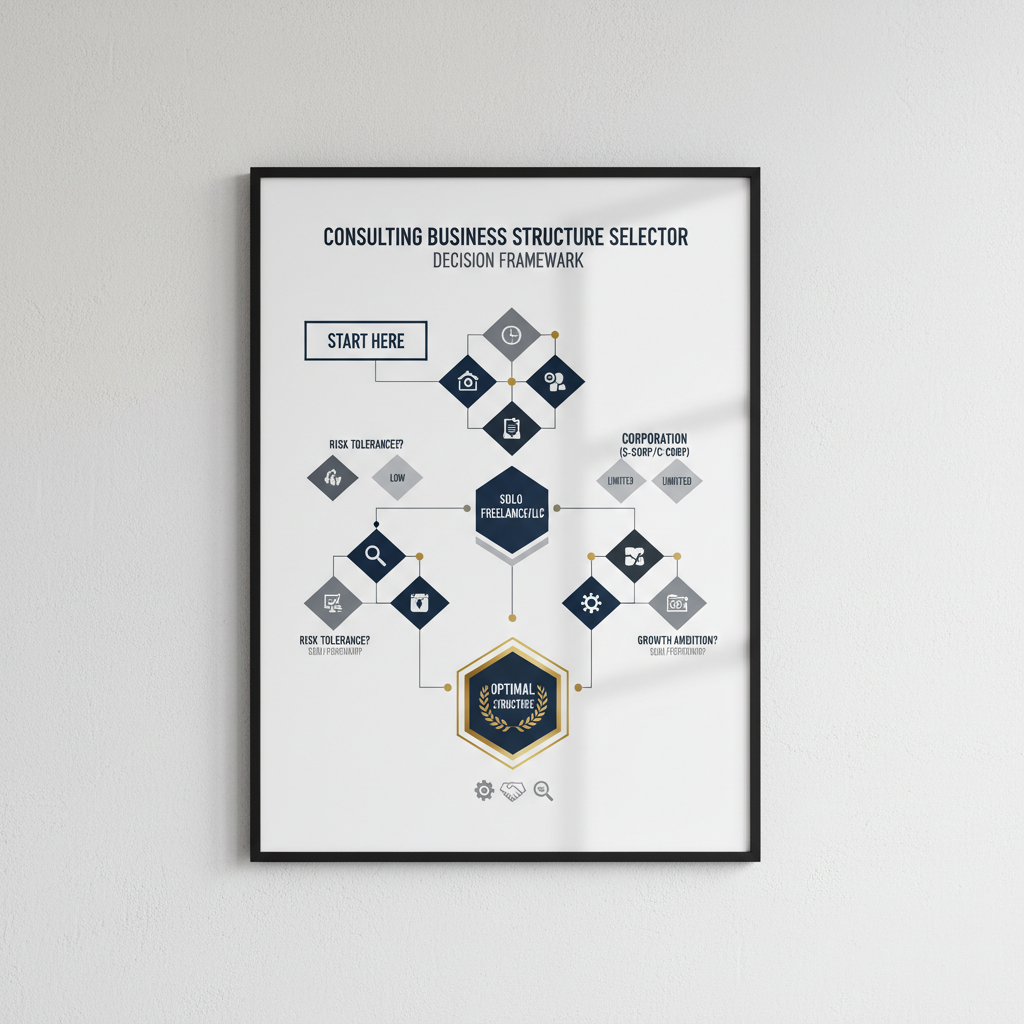
A minimalist, vector-based infographic depicting a step-by-step decision-making framework for selecting the optimal consulting business structure. The visual features interconnected geometric or isometric shapes arranged in a logical flow, leading to a central ‘optimal structure’ icon. The color palette is deep navy, charcoal, and white, with silver or gold highlights marking progression points. The design is clean, professional, and incorporates negative space for conceptual clarity, conveying a results-driven and actionable process.
Consider Your Firm’s Size and Scalability
To pick the right consulting company structure, first look at your firm’s current size. Then, think about its future growth. A solo consultant’s needs are very different from a firm with ten employees.
For solopreneurs or very small teams, a simpler structure often makes sense because you need flexibility. Still, you should think about where you want your business to be in 3-5 years. Do you plan to expand your team or offer new services?
Solo or Micro Firms: Focus on easy setup and simple operations. Sole proprietorships and single-member LLCs are common choices.
Growing Small Businesses: As you add partners or employees, you’ll need a structure that works for multiple owners. Partnerships or multi-member LLCs are good options.
Scaling for the Future: Choose a structure that supports your small business growth. It should make it easy to add new services and team members.
Remember, a structure that supports business automation early on helps even small firms run more efficiently. This makes it easier to scale later. Automated-Biz offers online business solutions built for this type of growth, so you’re ready when it’s time to expand.
Align Structure with Your Service Specialization
Your consulting services should shape your business structure. Your specialty affects how you work with clients and how your team manages projects.
Niche Specialists: If you focus on one area, like social media automation or lead generation strategies, a simple structure works well. This lets experts work directly with clients and make decisions quickly.
Broad Service Providers: If you offer many services, like general management or full small business marketing services, a structure with different departments might be better. This lets teams focus on specific areas and deliver consistent quality.
Project-Based Firms: Many consultants work project by project. A matrix structure can be very effective here. In it, consultants report to both a department manager and a project manager. This helps with sharing resources and working together across teams.
Your structure should make it easier to share your expert knowledge and support the way you work with clients. Good branding and website creation are key. They show potential clients what you specialize in. Automated-Biz can help you build that professional online presence.
Factor in Liability and Tax Implications
Protecting yourself legally and saving on taxes are key for any consulting business. Your business structure affects both your personal liability and how much you pay in taxes.
Here’s a look at common structures and what they mean for you:
Sole Proprietorship: This is the easiest to set up, but it offers no protection for your personal assets. If the business has debts or gets sued, your personal property is at risk. Filing taxes is simple.
Limited Liability Company (LLC): An LLC protects your personal assets from business debts. This is a huge benefit for small business owners. Profits and losses “pass through” to your personal tax return, which helps you avoid double taxation. For many, an LLC is a good mix of protection and simplicity.
Corporation (S-Corp & C-Corp): Corporations offer the most liability protection because they are completely separate legal entities from the owners.
S-Corp: Profits and losses pass through to the owners’ personal income, avoiding corporate taxes. This can also lead to savings on self-employment taxes if you pay yourself a reasonable salary.
C-Corp: The business pays corporate income tax on its profits. When profits are paid to shareholders as dividends, they are taxed again on a personal level (this is “double taxation”). C-Corps are often used by larger companies that want to raise money from investors.
It’s a good idea to talk to a lawyer and a tax professional. They can help you understand these details and choose the best structure for you. This is a key step for your business’s long-term financial health [2]. While Automated-Biz focuses on operational growth, we encourage smart decisions in all parts of your business. Business process automation can also make it easier to keep financial records, no matter which structure you choose.
Plan for Future Growth and Team Expansion
Your business structure shouldn’t just work for you today; it should also support your future goals. A good consulting company structure is scalable, meaning it can grow with you without needing major changes.
Consider these points for future growth:
Think About Team Size: Do you plan to hire employees, use contractors, or add partners? Some business structures make it easier to add new people than others.
Plan for Getting Clients: As you grow, how will you manage more clients? Good automated sales funnels are key. They help you get a steady stream of new leads and clients.
Handle More Work: Growth means more projects and tasks. Business process automation is a must-have to keep things running smoothly. It turns messy manual tasks into simple, automated ones.
Expand Your Reach: Do you want to enter new markets or add new services? Your structure needs to be flexible enough for these changes.
Automated-Biz offers online business solutions that help you scale. Our tools assist with lead generation strategies, online reputation management, and taking care of your clients. This helps you move from slow growth to a scalable business. Our platform lets you automate tasks without sacrificing quality, so your consulting business can grow smarter and faster while always looking professional.
What Do Consulting Company Structure Examples Look Like in Practice?
Example: The Small Boutique Consulting Firm
Many entrepreneurs start their journey as a small boutique consulting firm. This is often a sole proprietorship or a single-member LLC. You are likely the main consultant, salesperson, and manager all in one.
Typically, these firms focus on a specific niche. They offer highly personal services to a small number of clients. Growth depends heavily on a good reputation and word-of-mouth referrals.
Operationally, small firms are lean and flexible. However, it can be overwhelming to manage everything. This includes finding new clients, delivering projects, and handling administrative tasks.
Here’s how a small boutique firm often works:
Structure: Usually a Sole Proprietorship or LLC.
Team: One to three core consultants. They may hire freelancers for specific tasks.
Focus: Deep expertise in a niche market. Examples include social media strategy for local businesses or specialized financial consulting [5].
Client Engagement: High-touch, personalized service. Strong relationships are key for repeat business.
Decision-Making: Fast and centralized. The owner makes most of the decisions.
For small firms, the biggest challenge is growing without burning out. You need consistent ways to generate new leads. A professional online presence is also essential. Automated-Biz offers integrated solutions to make this easier. For instance, our platform helps you create a professional brand and website. It also simplifies social media automation and lead nurturing.
Example: The Mid-Sized Professional Services Organization
As a consulting firm grows, it often becomes a mid-sized professional services organization. This change usually involves moving from a sole proprietorship to an LLC or S-Corp. You also begin to build a more formal team.
Mid-sized firms offer a wider range of services to a larger, more diverse client base. They have dedicated teams for marketing, sales, project management, and client services.
The main goal is to grow in a structured way. They aim to deliver high-quality services consistently. Automating business tasks is essential for smooth operations. Without it, growth can become chaotic.
Consider the common traits of this model:
Structure: Often an LLC or S-Corp to provide liability protection and tax benefits.
Team: Five to fifty employees, including senior consultants, project managers, and support staff.
Focus: Multiple service lines or expertise in broader industries. They might serve clients in several different sectors.
Client Engagement: More structured client management. Standard processes help ensure consistent service.
Decision-Making: Somewhat decentralized. Team leads and department heads can make daily operational decisions.
A common problem for mid-sized firms is managing growth effectively. They need to find new leads consistently while keeping service quality high. They also want to automate tasks without losing a personal touch. Automated-Biz provides powerful business automation tools, like automated sales funnels and online reputation management. These tools help streamline operations and support scalable growth.
Example: The Large Firm Hierarchy (The Deloitte Model)
The large firm hierarchy, like that of companies such as Deloitte, is the biggest type of consulting structure. These are usually C-Corporations with a formal, multi-layered organizational chart.
These global companies offer a wide range of services. They serve large, corporate clients across many industries. Their structure is built to handle huge teams and complex projects around the world [6].
While Automated-Biz is designed for entrepreneurs and small business owners, it’s helpful to understand this model. It shows how large companies use strong systems to grow. Small businesses can use technology to apply similar ideas.
Key elements of a large firm include:
Structure: A complex C-Corporation, which allows for global operations and raising significant capital.
Team: Thousands of employees organized by practice area, industry, and geographic location.
Focus: A wide range of consulting services, including strategy, technology, human resources, and risk advisory.
Client Engagement: Highly structured projects. Teams often work on large, long-term contracts.
Decision-Making: Spread out but hierarchical. Partners and executives lead major strategic decisions.
The large firm model focuses on efficiency, standardization, and knowledge sharing. While your small business may not reach this size, you can copy its core strengths. Automated-Biz helps you build a professional online presence and streamline operations with integrated tools. This makes your business appear trustworthy and allows you to automate processes for scalable growth.
By using expert-driven tools, you can move from DIY guesswork to guided business automation. This allows even small firms to achieve a level of professionalism that was once only possible for large corporations.
How Can Automation Streamline Your Chosen Structure?
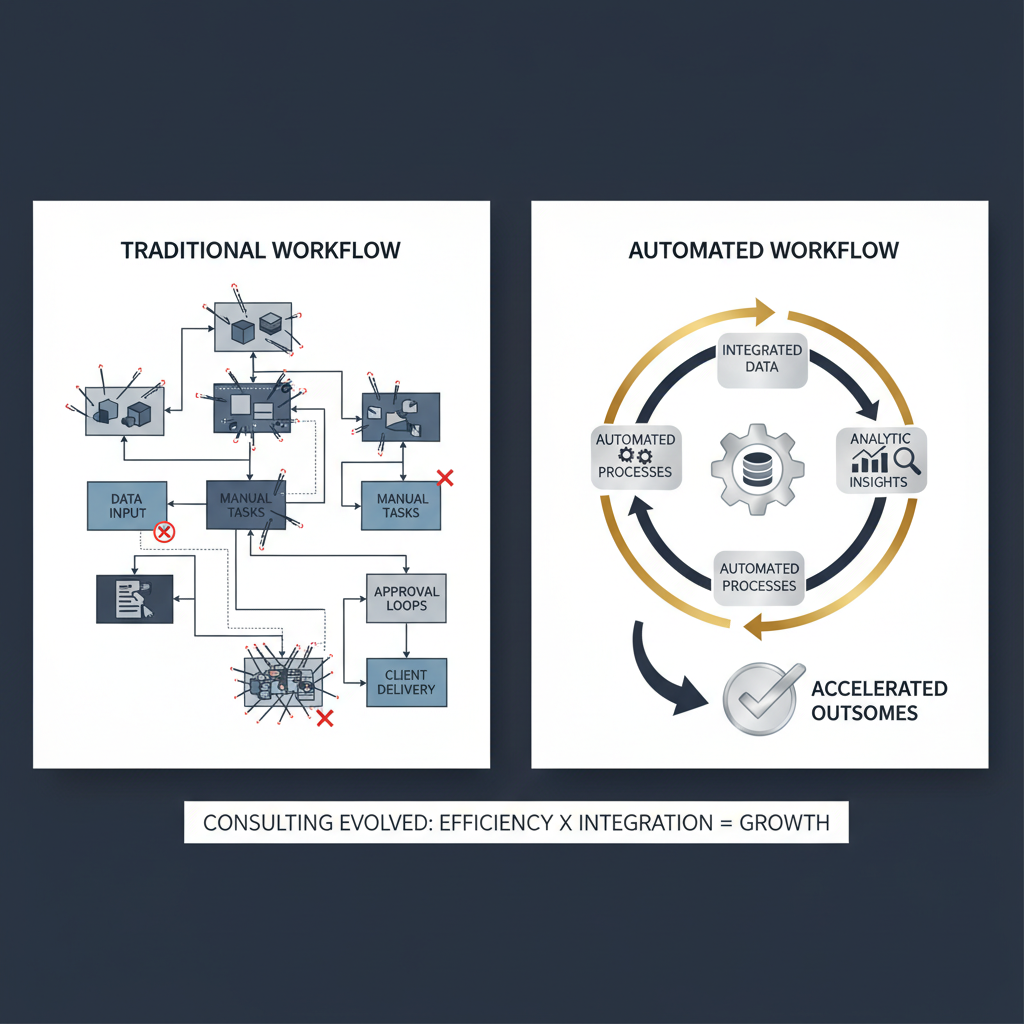
A minimalist, vector-based infographic demonstrating the streamlining power of automation within a consulting company structure. The visual contrasts a less efficient, multi-branched process flow with a clean, linear, or cyclical automated workflow. Use abstract icons representing data, tasks, and system integration, rendered with clean geometric shapes, subtle gradients, and metallic silver or gold accents on a deep navy, charcoal, and white background. The infographic emphasizes efficiency, integration, and measurable outcomes, reflecting a premium and results-driven approach.
Choosing the right organizational structure[7] for your consulting firm is just the first step. To get the most out of it and drive small business growth, you need business automation. This powerful combination turns manual work into a smooth process, helping you grow smarter and faster.
Implementing Automated Sales Funnels for Client Acquisition
Finding it hard to get consistent leads for your consulting business? Finding clients manually takes a lot of time and often leads to unpredictable results. The answer is automated sales funnels. These systems guide potential clients through each step, from first learning about you to becoming a paying customer.
Automated sales funnels save you valuable time and bring in a steady stream of potential clients. This frees you up to focus on what you do best: providing great consulting services. Our platform makes the whole process simple. Here’s how:
Lead Capture Pages: Create professional landing pages to turn visitors into leads by easily collecting their contact information.
Automated Email Nurturing: Set up smart email sequences that build trust by educating potential clients over time, all automatically.
CRM Integration: Track every interaction and manage your leads easily. Automated-Biz connects with top CRM tools.
Behavioral Triggers: Send automatic follow-ups based on what potential clients do, reaching out with the right message at the right time.
The result? You turn random inquiries into a predictable way of getting new clients. This is essential for growing your business.
Using Business Automation to Manage Projects and Deliverables
Consulting firms often manage many client projects, tight deadlines, and complex work. Without good business process automation, it’s easy to become disorganized and miss opportunities. Automated workflows help your projects run smoothly and keep quality high without adding more manual work.
Automated-Biz helps you make your operations more efficient. Our tools are designed to support your firm’s structure. Here are some key areas where you can use automation:
Task Management: Automatically assign tasks and track progress so every team member knows what they need to do.
Client Communication: Schedule automatic updates and progress reports for clients. This keeps them happy and informed without extra work for you.
Document & Asset Management: Keep all your files in one place with version control. Share documents securely and automatically, so everyone has the latest version.
Feedback Loops & Approvals: Speed up project timelines by automating requests for client feedback and approvals.
Time Tracking & Invoicing: Use automated time tracking to generate invoices based on project hours, making your billing more efficient.
With this kind of automation, you can replace disorganized manual work with smooth, efficient processes. It makes your whole firm more productive.
Building a Professional Online Presence to Support Your Brand
In today’s world, a professional online presence is a must-have for any consultant. It helps you build trust, show your expertise, and attract the right clients. Automated-Biz offers all-in-one solutions for branding and website creation, social media, and online reputation management.
Our platform makes sure your online presence always reflects your expertise. Here’s how we help:
Custom Branding & Website Design: We help you develop a professional brand and launch a high-quality website designed to turn visitors into clients.
Social Media Automation: Plan and schedule content for all your social media channels. You can stay active and build your social media marketing without the constant manual work.
Online Reputation Management: Keep track of reviews and automatically ask happy clients for feedback. This builds trust and credibility with new prospects.
Consistent Content Distribution: Automatically share your blog posts, case studies, and other content to position your firm as an expert in your field.
Using Automated-Biz means you can stop guessing and start using expert-guided business automation. This helps you create a strong and professional online brand, which is key to long-term growth.
Frequently Asked Questions
What is the best organizational structure for a consulting business?
There is no single “best” organizational structure for every consulting business. Your ideal structure depends on several factors.
Consider your firm’s size, services, growth plans, and legal or tax preferences. For example, a solo consultant has different needs than a firm with multiple partners.
Here are key elements to evaluate:
Your Firm’s Size: Are you a solo consultant or do you have a team?
Service Specialization: Do you offer niche services or a broad range?
Liability Concerns: How much personal asset protection do you need?
Tax Implications: Which structure offers the best tax treatment for your earnings?
Growth Ambitions: Do you plan to scale quickly or stay a boutique firm?
Common structures include sole proprietorships, partnerships, LLCs, and corporations. These options differ in liability protection, taxes, and how complex they are to manage. Research shows that LLCs are a popular choice for new businesses, offering flexibility and liability protection [source: https://www.sba.gov/business-guide/start-your-business/choose-business-structure].
No matter which structure you choose, Automated-Biz has the tools to support your growth. Our platform helps you manage your online business solutions and simplify your business process automation. This lets you focus on strategy, not day-to-day administrative tasks.
What is a typical consulting firm hierarchy structure?
A typical consulting firm, especially a larger one, has a clear hierarchy. This structure creates defined roles and a path for career growth.
Smaller firms, however, often have a flatter structure. This allows them to be more agile and communicate directly. If your firm is growing, knowing these roles can help you build your team.
Common roles in a hierarchical consulting firm include:
Analyst: An entry-level role focused on data collection, research, and analysis.
Consultant: Manages parts of a project, talks with clients, and develops solutions.
Manager: Oversees project teams, manages client relationships, and ensures projects are delivered on time.
Senior Manager/Principal: Leads multiple projects, helps bring in new business, and mentors junior staff.
Partner/Director: Holds a senior leadership position, responsible for firm strategy, finding new clients, and overall growth.
Even with a clear hierarchy, business automation can make your firm more efficient. Automated-Biz supports your team by reducing manual tasks at every level. Our productivity workflows help projects run smoothly, from research to client reporting. This improves operations and supports your small business growth.
What is a good structure for a small consulting firm?
For a small consulting firm or a solo consultant, simplicity and flexibility are key. A lean structure lets you focus on serving clients and achieving small business growth.
Many small firms start as a Sole Proprietorship because it’s easy to set up. However, an LLC (Limited Liability Company) is often a better choice. An LLC protects your personal assets by keeping them separate from your business. This gives you peace of mind as your business grows.
A good structure for a small consulting firm focuses on:
Clear Service Offerings: Define your niche to attract the right clients.
Client Focus: Build strong relationships through great service.
Efficient Operations: Automate administrative and marketing tasks.
Scalability: Choose a structure that can change as you grow your team or services.
If you feel overwhelmed with marketing and operations tasks, use technology to help. Automated-Biz offers a complete set of online business solutions designed for small consulting firms. We help you automate workflows without losing quality.
Our platform provides:
Professional Branding and Website Creation: Build a credible online presence instantly.
Automated Sales Funnels: Automate your lead generation strategies and client signup process.
Social Media Automation: Maintain consistent engagement online with less effort.
Online Reputation Management: Build trust and improve your credibility.
Integrated CRM: Manage leads and client relationships in one place.
With Automated-Biz, you can go from struggling to grow your business online to getting clients predictably. Our tools help you appear professional and trustworthy online, saving you time and increasing revenue through smart business automation.
Project management consulting provides businesses with external expertise to plan, execute, and manage projects effectively. For entrepreneurs and small business owners, consultants streamline complex operations, implement business automation tools, and ensure key initiatives are completed on time and on budget to accelerate growth.
Growing your small business can be a challenge. You may be trying to expand online, feeling overwhelmed by marketing and daily tasks, or looking for ways to automate work without losing quality. To build a professional online presence and get a steady flow of leads, you need more than just hard work. You need the right systems to save time, work more efficiently, and get real results.
This is where expert project management consulting comes in. A consulting firm can provide the structure and guidance to improve your operations, helping with everything from business process automation to building effective sales funnels. This guide will explain what Project management companies do and show how they help businesses grow and automate efficiently. The goal is to help you find new clients consistently and achieve steady small business growth.
We’ll cover the main services these firms offer, give you tips on how to choose the right partner, and show you how to blend their skills with your current systems for long-term success. By the end, you’ll have a clear and simple plan to use project management to streamline your work and earn more money. First, let’s define what project management consulting is and why your business might need it.
What Is Project Management Consulting (and Why Do You Need It)?
A project management consultancy provides your business with expert help from an outside source. They help you reach your project goals, improve how you work, and drive steady growth. Think of them as experienced guides who offer a clear plan for handling complex projects.
Unlike an employee, a consulting firm gives you an unbiased view. They find weak spots in your process and create practical solutions. Their main job is to make sure your projects finish on time, on budget, and meet your quality standards. Many also set up tools to automate business tasks. This saves time and helps your team get more done.
They offer expert guidance for tough projects.
They improve workflows to increase efficiency.
They use proven methods to help projects succeed.
They help you add new tools and technology.
They make sure your projects support your main business goals.
Key Signs Your Business Is Ready for a Consultant
As small businesses grow, they often face the same problems. You might be struggling to expand your business online. Or maybe you feel swamped with marketing and daily tasks. These are clear signs that a consultant could help. Look for these specific signs:
Project Overruns: Your projects are always late or over budget.
Lack of Direction: You don’t have a clear plan for your marketing or growth.
Inconsistent Leads: You struggle to find new customers consistently.
Automation Hurdles: You want to automate tasks, but it seems too hard to get started.
Growth Stagnation: Your business has stopped growing, even though you’re working hard.
Team Overwhelm: Your team is overworked and juggling too many responsibilities.
Professional Presence: You want a professional online image but need help with branding and website creation.
Technology Gaps: You have trouble making new software work with your current tools.
If these problems sound familiar, a consultant can give you the clear, actionable plan you need.
How Consultants Drive Automation and Business Growth
A project management consulting firm offers more than just advice. They deliver real, measurable results. They help change your business from manual to automated, from unpredictable to reliable, and from slow to ready-for-growth. For example, businesses that use automation well often see a big jump in efficiency and get more done [1].
Streamlined Workflows: Consultants look at how you work now. They find what’s slowing you down. Then, they design optimized business process automation that turns messy manual tasks into smooth operations.
Technology Integration: They help you pick and set up the right software. This includes connecting tools like automated sales funnels so you can find new customers smoothly.
Scalable Digital Systems: A consultant builds strong marketing systems that grow with you. These systems help you find new clients and build relationships with them. They also improve your social media and content planning.
Enhanced Online Presence: They guide you in building a professional brand and website. This makes your business look trustworthy online. They also help manage your online reputation.
Data-Driven Decisions: Consultants use data to show you what’s working. This moves you from guesswork to expert-guided business automation, leading to a steady stream of new and returning clients.
Time and Resource Savings: Automating repetitive tasks saves your team valuable time. They can then focus on more important work, which helps your business grow smarter and faster.
Expert Guidance: They offer hands-on support and training. This teaches your team new, time-saving ways to work and sets you up for long-term success.
What Core Services Do Project Management Consulting Firms Offer?
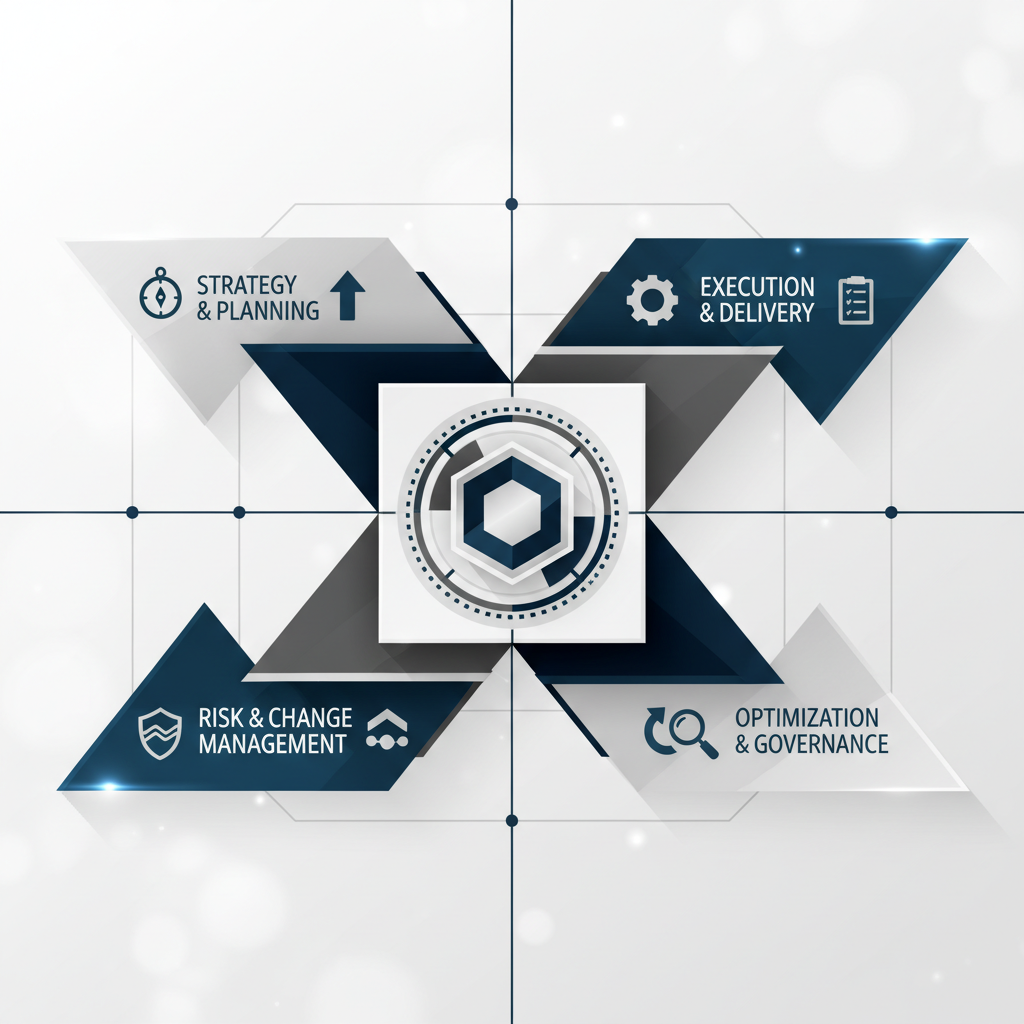
An executive-level infographic representing core project management consulting services. Use abstract business visualization with clean, minimalist vector-based geometric shapes in deep navy, white, and charcoal, accented with silver highlights. The visual should depict a central hub from which distinct service categories branch out or surround, illustrating a structured offering. Ensure ample negative space for short labels and maintain a professional, premium aesthetic. No humans, no photographs, no cartoon elements.
Strategic Planning and Project Initiation
Starting a new project can feel overwhelming. Many small business owners struggle with unclear goals, which can waste time and money. A project management consulting firm helps you build a solid foundation. They turn your big ideas into a clear, actionable plan.
Consultants work with you to clarify your vision. They make sure your project goals match your overall small business growth strategy. This important first step prevents costly mistakes down the road. It helps set you up for success.
Key services in this phase include:
Vision and Goal Definition: Consultants help you define what success looks like. They turn your big ideas into specific, measurable goals.
Scope Development: They set clear boundaries for your project. This prevents “scope creep,” where extra tasks get added without a plan. A clear scope saves time and money.
Feasibility Studies: Before you invest time or money, consultants check if your project is workable. They spot potential problems and opportunities early on.
Stakeholder Alignment: They make sure everyone involved is on the same page. This encourages teamwork and helps avoid conflicts later.
Roadmap Creation: A detailed roadmap shows key steps and deadlines. This gives your team a clear path to follow.
By investing in planning, you get clarity and direction. Planning ahead greatly increases your project’s chances of success [2]. It builds a strong foundation for every step that follows.
Business Process Automation and Workflow Design
Many entrepreneurs feel swamped by marketing and daily tasks. Doing things by hand drains your time and money. Project management firms are great at finding these bottlenecks. They then design efficient, automated systems to solve these problems.
Consultants help you move from separate tasks to connected systems that work together. They use powerful business automation tools to boost productivity and get consistent results.
Key services include:
Workflow Analysis: Consultants first look at how you currently work. They find slow spots and tasks that could be automated.
Automated Workflow Design: They design better workflows for you. These new systems connect your different online tools so things like sales funnels can run on their own.
Technology Implementation: They help you choose and set up the right automation software, like CRM systems, marketing platforms, and project management tools.
System Integration: Your new systems will be connected, not separate. This lets information flow smoothly and gets rid of manual data entry.
Lead Generation Strategies: Consultants can build automatic systems to find new leads. This brings in a steady stream of potential customers.
Social Media Automation: They can set up tools to schedule social media posts. This frees up your team for more important work.
The change is powerful. You go from getting inconsistent results to having predictable systems. Your work becomes smoother, helping you grow smarter and faster. This saves countless hours so you can focus on growing your business.
Resource and Risk Management
Even with a great plan, projects can face challenges. Resources might be limited, or unexpected problems can pop up. Project management consultants help businesses handle these issues. They plan for the best use of your resources and how to reduce risks.
This proactive approach protects your investment. It helps keep your projects on track and on budget. Consultants act as expert advisors, spotting problems before they become crises.
Core offerings in this area include:
Resource Planning: They figure out the people, budget, and tools you need. This makes sure you have what you need, right when you need it.
Budget Management: Consultants create a realistic budget and track spending to prevent cost overruns. This financial control is key for a growing business.
Risk Identification: They look ahead to spot potential roadblocks for the project, from tech failures to changes in the market.
Risk Assessment and Mitigation: For each risk, they figure out its potential impact. Then, they create solid backup plans to keep things running smoothly.
Scheduling and Timeline Optimization: They create realistic timelines and adjust them as needed to keep the project moving forward.
Quality Assurance Planning: They build quality checks into the project from the start. This ensures the final results meet high standards.
This expert guidance helps you avoid common problems. It leads to more predictable project results, allowing your business to move forward with confidence.
Project Execution and Performance Tracking
Once a project is planned and resources are in place, getting the work done right is key. A project management consulting firm doesn’t just plan; they also oversee the work as it happens. They make sure your automated systems are running smoothly.
This phase is all about turning plans into reality. It focuses on tracking progress and keeping everyone accountable. Consultants provide the hands-on support needed to get real results.
Key aspects of project execution and tracking include:
Oversight and Guidance: Consultants supervise the project from start to finish. They offer expert advice to your team along the way.
Performance Metric Definition: They help you set up clear Key Performance Indicators (KPIs). These numbers track the project’s health and success.
Regular Reporting: You get regular updates on the project’s status. These reports show progress, challenges, and what’s next.
Quality Control: Consultants put checks in place to maintain high standards. They make sure all the final work meets your requirements.
Change Management: Projects often need adjustments. Consultants handle these changes smoothly to minimize disruption.
Post-Project Review: After the project is done, they lead a review to see what went well. This helps identify lessons for future projects and supports long-term success.
This careful approach helps ensure projects are delivered on time and within budget. It moves your business toward systems that can grow with you. You get measurable results and a clear path to growing your revenue.
How to Choose the Best Project Management Consulting Firm
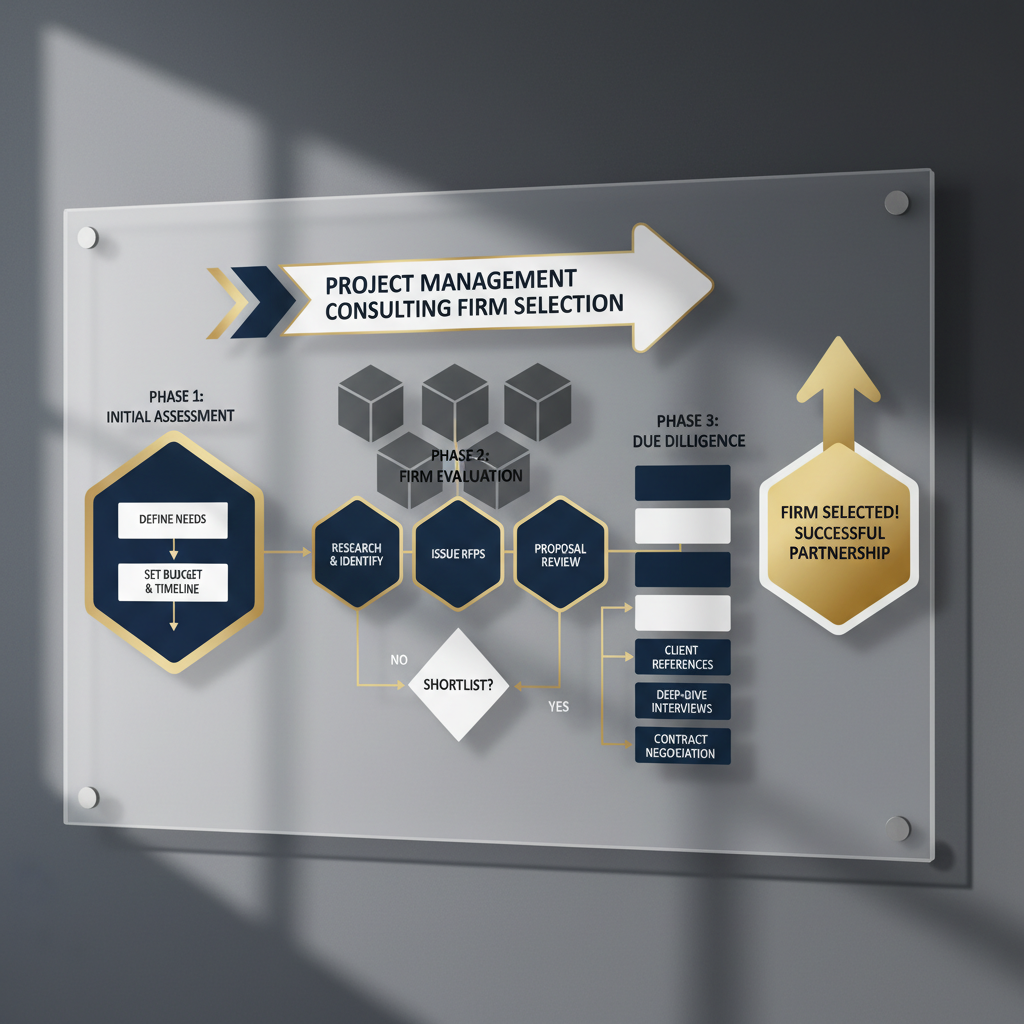
An executive-level infographic demonstrating a step-by-step process or a layered framework for selecting a project management consulting firm. Utilize abstract business visualization with clean, minimalist vector-based geometric or isometric shapes, featuring subtle gradients. The color palette should be deep navy, white, and charcoal, with gold accents. The layout should convey progression and clear decision points, with structured grouping and visual hierarchy. Include open areas for short labels. No humans, no photographs, no cartoon elements.
Choosing the right project management consulting firm is key to growing your small business. The right partner can improve your operations, saving you time and increasing revenue. A well-informed choice helps secure your long-term success.
Assess Their Experience with Small Businesses
Your small business has unique needs that are different from large companies. It’s important to pick a consulting firm with proven experience working with small businesses like yours.
Find a firm that understands limited budgets and the need for flexible solutions. They should know about online business tools and the challenges entrepreneurs face. Their skills should directly help you automate your business.
Consider these points:
Relevant Portfolio: Do they show successful projects with businesses like yours?
Understanding of Scale: Can they adjust their methods for a smaller team and budget?
Growth-Focused Approach: Do they focus on plans that help small businesses grow?
Automation Familiarity: Are they skilled in setting up business process automation for growing companies?
A consultant who really knows the small business world can guide you well. They can help you set up automated sales funnels and strong lead generation plans. This will save you time and get you better results.
Evaluate Their Methodology and Tools
A consulting firm’s methods and tools show if they are a good fit. Their approach should match how you work and what you want to achieve. They also need to work well with the online tools you already use or plan to use.
Ask detailed questions about their process and the specific tools they use. This makes sure their advice is practical and easy to put into action for your business.
Key areas to assess include:
Project Management Frameworks: Do they use Agile, Lean, or a hybrid approach? How will this benefit your specific projects?
Automation Software: Are they skilled with popular business automation tools? Can they help you automate workflows efficiently?
Digital Marketing Systems: How do they include digital marketing in their project plans? Do they understand social media automation and lead nurturing?
Integration Capabilities: Can they connect new systems with the technology you already use? This includes your CRM, website, and tools for branding and website creation.
Scalability of Solutions: Will their recommended tools and methods grow with your business?
The right methods and tools can turn messy workflows into a smooth process. This helps you get new clients more consistently.
Look for a Focus on Measurable Outcomes
Hiring a consultant is an investment, so you need to see a clear return. Choose firms that focus on results you can measure. They should give you a clear plan for success.
Talk about specific Key Performance Indicators (KPIs) from the start. Understand how they will track progress. This holds them accountable and shows you their true value.
Insist on a results-driven partnership:
Clear Goals: Do they help you define specific, measurable, achievable, relevant, and time-bound (SMART) project goals?
ROI Focus: How will their work lead to more revenue, saved time, or better efficiency?
Reporting Standards: What kind of reports will you receive? How often? These should clearly show progress and results.
Post-Implementation Support: Do they offer support after the setup to make sure the changes lead to long-term growth?
A consultant focused on results helps you move from guesswork to predictable success. They turn your investment into real improvements for your online presence and your whole business.
Review Case Studies and Client Testimonials
Proof of past success is very important. Carefully review a firm’s case studies and client testimonials. These give you real-world examples of what they can do and if they are reliable.
Look for examples that match your own business challenges. Pay attention to the specific problems they solved and the results they delivered. Real testimonials show you what it’s like to work with them.
When reviewing these resources:
Relevant Industries: Do their case studies include businesses in your industry or with a similar setup?
Specific Results: Look beyond general statements. Do they measure the improvements, like a percentage increase in leads or shorter project timelines?
Client Satisfaction: Are testimonials consistently positive? Do clients talk about the consultant’s professionalism, knowledge, and ability to get results?
Problem-Solving Approach: How did the firm handle unique problems? Did they offer creative online business solutions?
Online Reputation Management: Check the firm’s own online presence and reviews. A firm that manages its own reputation well is often good at helping its clients do the same.
This information helps you judge if the firm can deliver on its promises. It gives you confidence that they can provide expert advice and hands-on support for your business automation and growth goals.
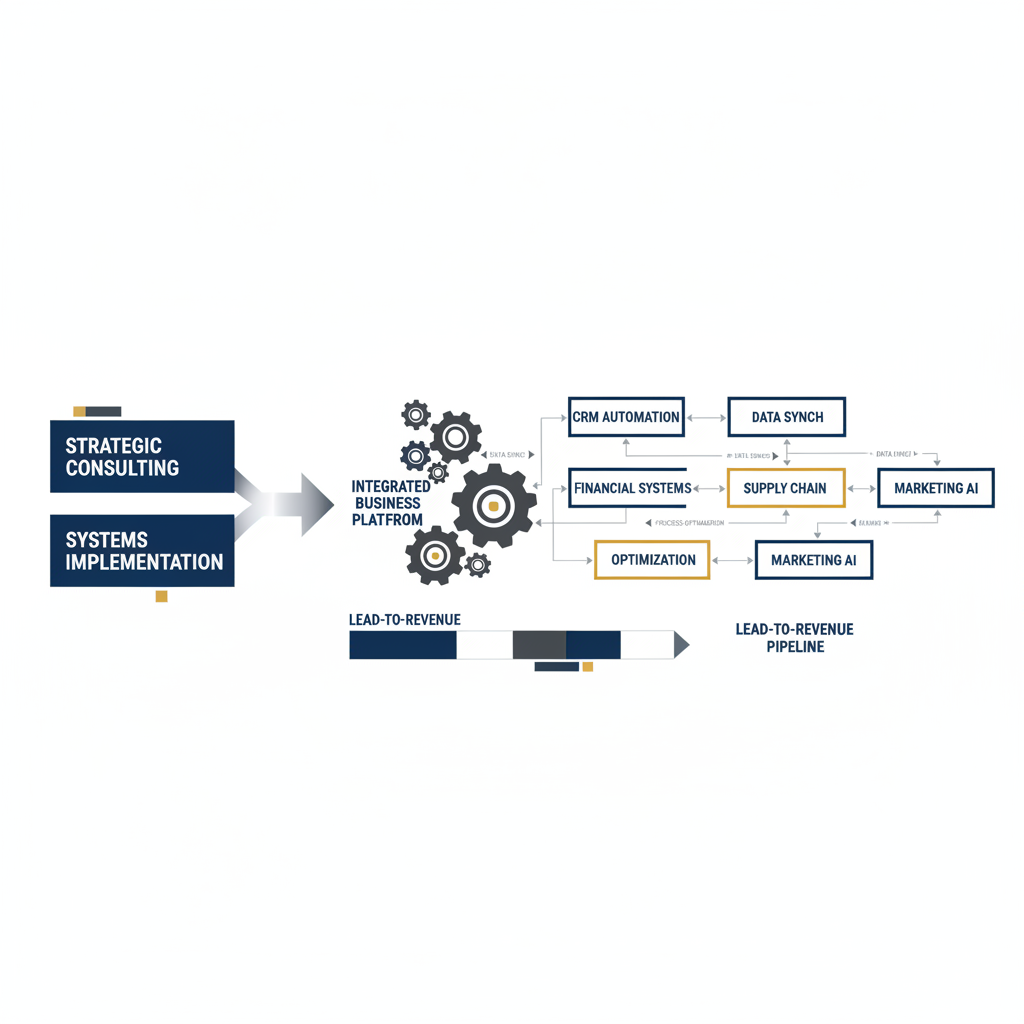
Integrating Consulting with Your Automated Business Systems
An executive-level infographic visualizing the integration of consulting services with automated business systems. Depict this using abstract business visualization, such as an automated workflow diagram, a network of interconnected systems, or a lead pipeline. Employ clean, minimalist vector-based geometric or isometric shapes with subtle metallic accents (silver/gold). The color scheme should be deep navy, white, and charcoal. Show seamless data flow and connectivity between different abstract system blocks. Ensure ample negative space for clarity and short directional markers. No humans, no photographs, no cartoon elements.
Connecting Project Management to Your Sales Funnels
To grow your business predictably, you need to connect your project management to your sales funnels. A project management consultant helps you turn customer interest into happy, onboarded clients. They do this by treating each step of your customer’s journey like a well-managed project.
Here’s how a project management consultant works with your sales process:
Mapping the Customer Journey: Consultants map out every stage of your sales funnel, from getting leads to making a sale. This gives potential clients a clear path to follow.
Streamlining Lead Nurturing: They set up systems to nurture leads consistently. This includes automated emails and timely follow-ups, so you don’t have to do it manually.
Optimizing Sales Handoffs: A key step is creating a smooth handoff from your sales team to your service team. This avoids confusion and keeps clients happy.
Tracking Performance: Using project management, you can track how well your funnels are working. You’ll find and fix any slow spots to get more conversions.
Predictable Client Acquisition: When you treat your sales funnel like a project, getting new clients becomes more predictable. This is essential for steady growth and income.
This approach is key for small businesses that are struggling to find new leads and grow online. Your automated sales funnels will work better and more efficiently, bringing in a steady stream of new clients.
Using Consultants to Optimize Your Tech Stack
Your “tech stack” is the set of software and tools you use to run your business. For many owners, juggling different systems can be overwhelming. A project management consultant offers expert help to make these tools work better together.
Automated-Biz gives you a single platform, and a consultant helps you get the most out of it and connect it with other tools you use. Their goal is to automate your business tasks across every system.
Comprehensive System Audit: Consultants start by reviewing your current tools. They find what’s overlapping, what’s missing, and what can be improved.
Seamless Integrations: They help connect all your platforms, such as your CRM, email marketing, and social media tools. For example, integrating customer relationship management (CRM) systems can improve sales productivity by 15% [3].
Workflow Automation Design: They build custom workflows to automate repetitive tasks. This frees you up to focus on growing your business instead of on data entry.
Leveraging Automated-Biz Features: A consultant makes sure you use all of Automated-Biz’s built-in services, including website creation, sales funnels, and online reputation management.
Cost and Efficiency Gains: A fine-tuned tech stack saves you time and makes your operations more efficient. You can automate tasks without sacrificing quality.
By streamlining your digital tools, you can turn separate systems into one powerful engine for growth. This expert support is key for any business that wants to look professional and trustworthy online.
Building Scalable Systems for Long-Term Success
Scalability means your business can handle more customers without you having to work harder or spend more. A project management consulting firm is key to building these scalable systems. They help you move from slow growth to steady, long-term expansion.
Long-term success takes more than quick fixes. It requires a smart plan for automation and growth. This is where consultants can really help.
Future-Proof Workflow Design: Consultants create workflows that can grow with your business. They set up clear steps for finding leads, onboarding clients, and delivering your service.
Documentation and Training: They help write down how your new automated systems work. This keeps everything consistent and makes it easy to train new team members as you grow.
Performance Monitoring Frameworks: A consultant sets up systems to track your performance over time. This helps you keep improving and adjusting your strategy.
Strategic Planning for Expansion: They work with you to create a plan to enter new markets, launch new products, or expand your services.
Leveraging Automated-Biz for Growth: Automated-Biz provides a strong foundation for this growth, with tools for social media, marketing, and keeping clients happy.
Building scalable systems changes your business from one with inconsistent results to one with predictable systems. You go from guessing on your own to using expert-guided automation, making sure your hard work pays off for years to come.
Frequently Asked Questions
What is the main role of a project management consultant?
A project management consultant is an outside expert. They help small businesses and entrepreneurs handle complex projects. Their main job is to improve efficiency and drive small business growth. They find problems and put smart solutions into action.
These consultants create clear processes to help you meet your goals on time and on budget. They turn disorganized projects into successful ones. This frees you up to focus on your main business tasks.
Key responsibilities include:
Strategic Planning: Defining a project’s goals, scope, and what it needs to deliver.
Business Process Automation: Designing workflows that automate repetitive tasks to save time and money.
Risk Management: Finding potential project risks and creating plans to avoid them.
Performance Optimization: Reviewing how your business works and suggesting improvements to make it more productive.
Technology Integration: Recommending the right tools and making sure they work together smoothly for your online business solutions.
With expert help, businesses greatly improve their project success rates [4]. They move from manual, disconnected work to smooth, automated operations.
How do I find the best project management companies?
Finding the right project management consulting firm is key for small business growth. Start by outlining your specific needs and project goals. Think about which areas need the most help, like automating workflows or generating more leads.
Look for a project management consultancy with a history of success. They should have experience with businesses like yours. Make sure their skills match your goals, whether you need automated sales funnels or help with branding and website creation.
Follow these steps to find the best fit:
Assess Industry Experience: Choose firms that know your industry well.
Evaluate Their Process: Look for consultants with a clear, organized approach who focus on measurable results.
Check for Automation Expertise: Make sure they are experts in business process automation and integrated systems. This is vital for modern online business solutions.
Review Client Testimonials and Case Studies: Past results show what they can do. Look for proof of how they saved clients time or increased their revenue.
Focus on Communication and Support: Choose a firm that communicates clearly and offers dedicated support to build a strong partnership.
Consider an All-in-One Service: Many small businesses benefit from integrated services. Automated-Biz, for instance, provides a complete platform for business automation and growth that works alongside expert consulting.
The best firms give practical advice you can use right away. They help you build systems that bring in steady leads and improve your online presence.
What is the difference between a consultant and a project manager?
Both roles are important for a project’s success, but a consultant and a project manager do very different things. Understanding this difference helps you use each one in the right way for small business growth.
A project management consultant usually works as an outside expert. They give high-level advice and find opportunities for improvement, such as through business process automation. They focus on the “what” and the “why” by finding problems and designing new solutions. Their job is often done once the new plan or system is in place. The global management consulting market continues to grow, highlighting the demand for this expert advice [5].
A project manager, on the other hand, is an internal role focused on daily operations. They are in charge of carrying out the project. They manage teams, schedules, and budgets, putting the consultant’s plans into action. They track progress and keep everyone updated, making sure the “how” gets done. Their focus is on execution and ensuring processes, like automated sales funnels, run smoothly.
In essence:
Consultant: Strategic, gives advice, has an outside perspective, finds problems, and designs solutions.
Project Manager: Hands-on, focused on getting things done, manages tasks, and handles daily work.
A consultant creates the plan for scalable business processes. A project manager then follows that plan to make sure the project succeeds.
Can a consultant help with construction project management?
Yes, absolutely. Project management consultants are very helpful in the construction industry. Construction projects are often complex, involve many people, and require careful planning to succeed.
A consultant who specializes in construction brings expert knowledge to the table. They help businesses handle the industry’s unique challenges, like managing large teams, tight deadlines, and big risks. Their goal is to make large projects more controlled and efficient.
In construction, a consultant can assist with:
Feasibility Studies: Checking if a project is practical and likely to be profitable.
Budget and Cost Control: Creating realistic budgets and finding ways to save money.
Schedule Optimization: Making detailed timelines and making sure deadlines are met.
Risk Mitigation: Finding and planning for common construction risks, like material delays or permit issues.
Compliance and Regulations: Making sure the project follows all local building codes and environmental rules.
Contract Management: Overseeing agreements with vendors to ensure everything is clear and work gets done right.
Technology Implementation: Recommending the right software for tracking progress, managing resources, and communicating with the team.
By making processes more efficient and providing expert guidance, these consultants help avoid expensive delays and budget issues. Research shows that poor project management is a leading cause of project failure in construction [6]. A skilled consultant brings an organized approach. They turn chaotic projects into well-managed successes, ensuring the work is finished efficiently and professionally.
A business development consultant is a strategic advisor who helps companies identify and act on new opportunities for growth. They specialize in creating long-term value by analyzing markets, building strategic partnerships, and optimizing sales and marketing processes to increase revenue and expand the business.
Growing a business online can be a struggle. Many entrepreneurs and small business owners feel overwhelmed by endless marketing and operations tasks. The path to sustainable small business growth seems difficult when you’re juggling everything yourself. What if you could use expert strategies and smart automation to move beyond the daily grind and truly scale your vision?
This guide explains the role of a business development consultant. They are a strategic partner who finds opportunities to expand your business. Their work goes beyond basic sales. A skilled advisor offers an outside view of your market, creates effective lead generation strategies, and helps you set up tools for growth. This includes business process automation and automated sales funnels. You will discover how these experts help you get consistent leads and build a professional online presence that turns prospects into loyal clients.
By understanding what these consultants do, you can shift from inconsistent growth to predictable scaling. We’ll explore how to use their insights to build systems that work for you, not against you. This covers everything from branding and website creation to social media automation and online reputation management. Get ready to learn how to automate workflows without losing quality, improve your digital marketing, and achieve the sustainable growth you want.
What is a Business Development Consultant?
The Core Role of a Business Development Advisor
A Business Development Consultant is an expert in long-term growth. Their main goal is to help your business grow and scale successfully. They don’t just focus on quick sales. Instead, they find new opportunities that create lasting growth. Think of them as the architect of your business’s future.
For entrepreneurs and small business owners often struggling to grow your business online, these advisors offer a valuable outside view. They look at how your business runs, your place in the market, and new ways to make money. Their goal is to take you from unpredictable results to a steady, reliable system for growth.
They take a big-picture approach, focusing on key areas for small business growth:
Finding New Markets: They find new groups of customers you haven’t reached yet.
Building Partnerships: They create partnerships to help you reach more people and do more.
Improving Online Presence: They help improve your branding and website creation to bring in new customers.
Making Work Easier: They suggest business process automation to simplify your work. This lets you automate repetitive tasks and save time.
Creating More Income: They find ways to boost your revenue. This could be through new products, services, or better sales methods.
In short, a business development advisor helps you build strong online business solutions. Their guidance turns scattered manual work into a smooth, automated system built for long-term success. They make sure you can scale your business in a smarter, faster way.
How They Differ From Sales Roles
People often confuse this role with sales, but they are very different. Both are important for making money, but their focus, timing, and methods are not the same. Knowing the difference helps you use each one’s strengths for small business growth.
A sales role is about making money now. Sales teams turn potential customers into actual buyers. They manage client accounts and follow set procedures. Their goal is short-term, like closing deals and hitting sales targets.
In contrast, a business development consultant thinks long-term. They prepare your business for future success, sometimes years ahead. Their work comes before sales and makes the sales team’s job easier. For example, they might find a new type of customer or create a new service that the sales team can sell later. Businesses that plan for growth in this way often grow 10-15% faster than businesses that only focus on sales [1].
Key distinctions include:
Aspect
Business Development Consultant
Sales Professional
Primary Focus
Long-term plans, finding new opportunities, building a foundation for growth.
Future-focused, looking 6-18 months ahead or more.
Immediate, focused on daily, weekly, or quarterly results.
Key Activities
Researching markets, negotiating partnerships, creating automated sales funnels, improving lead generation strategies, and designing systems.
Finding prospects, giving presentations, handling objections, closing deals, and following up with clients.
A consultant gives you the systems needed to find new clients consistently. They help you build connected marketing systems so you’re not overwhelmed with marketing and operations tasks. This foundation makes your sales team more effective. They get a steady flow of new leads and benefit from a stronger online presence.
What Key Responsibilities Does a Consultant Handle?
Market Opportunity Analysis
A good business development consultant analyzes market opportunities. They study your industry to find new trends, customer needs, and new market areas. This helps you make decisions based on data, not guesswork.
Their work helps small businesses find where to focus for the best results. This involves knowing your ideal customers and checking your competitors’ strengths and weaknesses. It’s about finding the perfect market spot for what you offer.
The goal is to find key areas for significant small business growth. Consultants use tools to collect and explain market data. This helps you understand customer behavior and see your market potential. For instance, companies that conduct good market research are 30% more likely to launch successful products [2].
With this information, you can create focused strategies. Automated-Biz helps you use these insights with tools for:
Branding and website creation that connects with your target audience.
Developing products or services that people need.
Crafting clear messages for your new markets.
Using online business solutions that match your growth goals.
Strategic Partnership Development
A business development consultant also helps build strategic partnerships. They find potential partners, negotiate deals, and build alliances that help everyone. These partnerships can speed up your small business growth without a large initial cost.
Consultants find other businesses that fit well with your company’s mission. These partnerships can open up new ways to sell your products or improve your services. For example, a partner could give you access to new customers or special skills.
Good partnerships can greatly lower the cost of getting new customers. They also make your brand more visible. The right partner can instantly add trust and credibility to your business, helping you look more professional online. This is very helpful if you find it hard to grow your online business alone.
A consultant’s help turns your solo efforts into team successes. Automated-Biz supports this by helping you look polished and professional:
Building a strong professional online presence with an expert website.
Ensuring you communicate clearly and consistently with potential partners.
Showing what you can do in a clear and convincing way.
Lead Generation Strategy and Implementation
Getting steady leads is vital for any business. A business consultant creates and uses effective lead generation strategies. They help you go from random inquiries to a steady stream of new clients.
This means figuring out who your ideal customers are and understanding their buying process. Then, they use different channels to attract and capture potential customers. This requires knowing which platforms and methods will work best for your business.
The consultant sets up systems to bring in a constant flow of potential clients. This is key for businesses that need more leads but are busy with other tasks. The goal is to create processes you can repeat and scale easily.
Automated-Biz turns these strategies into real results with integrated tools for:
Building high-converting automated sales funnels to capture and follow up with leads.
Using targeted social media automation to connect with people where they are.
Creating great content that attracts your target customers.
Making the first contact and qualification steps easier.
Improving your overall small business marketing services.
Sales Process Optimization and Automation
Finally, a consultant helps improve and automate your sales process. This means refining every step, from first contact to closing a sale, to be more efficient and get more conversions. They change manual, messy workflows into smooth, automated ones.
They review your current sales process to find problems and delays. The goal is to make buying easier and better for the customer. This also frees up your team to focus on important customer talks instead of paperwork.
The consultant uses strategies to close deals faster and increase your revenue. Automating repeat tasks helps you keep quality high as you grow. This is perfect for businesses that want to automate work without sacrificing quality.
Automated-Biz has the business automation tools to help you do this, including:
Setting up advanced automated sales funnels that guide customers smoothly through the buying process.
Integrating CRM (Customer Relationship Management) tools to manage clients well.
Automating follow-up messages to keep potential customers engaged.
Using online reputation management to build trust and close sales faster.
Providing expert support for business process automation to help you switch from manual to automated systems.
How Can a Business Development Consultant Drive Growth?
Create a clean, executive-level infographic. Visual direction: abstract business visualization, no humans, focus entirely on conceptual visuals. Subject: business growth charts, milestones, or KPI tracking visuals, layered frameworks, step-based processes, or hierarchical systems. Style: Minimalist, vector-based, professional, and premium. Clean geometric or isometric shapes with subtle gradients or metallic accents. Color Palette: Deep navy, white, charcoal, with silver or gold highlights for clarity, sophistication, and credibility. Negative Space & Layout: Leave open areas for short infographic labels or category indicators. Maintain structured grouping, visual hierarchy, and clarity. The infographic should depict a multi-faceted strategy for business growth: an isometric 3D visualization showing multiple growth pillars (representing areas like strategy, lead generation, automation, client nurturing) converging into a central, prominent upward-trending growth chart. Each pillar should have a distinct, minimalist icon at its base and subtle silver or gold accents emphasizing progression. The overall composition should be dynamic and aspirational, using deep navy, charcoal, and white backgrounds to highlight the silver/gold elements. The infographic should convey efficiency and strategic impact.
Gain an Objective, Expert Perspective
It’s easy to get lost in day-to-day work. This makes it hard to see the big picture. A business consultant gives you a fresh, outside view. They see past your company’s usual ways of thinking. This new perspective is key to growing your business long-term.
A consultant brings deep experience from many industries. They can quickly spot chances you might have missed. They also find weak spots in how you work. This includes tasks you could automate. They see what works, what doesn’t, and how to improve.
Their honest feedback helps you improve your business plan. They give you practical advice, not just ideas. This expert help turns guessing into a clear plan. As a result, you will feel more confident about how to grow.
Accelerate Entry into New Markets
Entering new markets offers big rewards. But it can also be very hard. A business consultant knows how to study new markets. They check if a market is a good fit for your business. This helps you avoid expensive mistakes and wasted time.
Their knowledge helps you enter markets faster. They create smart plans to find new customers. They study the people you want to reach and your competitors. They also suggest the best ways to contact them.
With a consultant’s guidance, you can:
Find the best groups of new customers.
Create a strong message for new buyers.
Plan marketing campaigns that work.
Use social media tools to reach new markets.
This expert help lets you grow faster and smarter. It opens the door to new ways of making money.
Build Scalable and Automated Systems
Growing a business takes more than hard work. You need systems that can handle more work as you grow. A consultant helps you build systems that scale. They help you switch from slow, manual tasks to smart business automation.
They can design and set up automated sales systems for you. These systems find and connect with new customers automatically. This makes getting new clients easier. It frees up your time for big-picture thinking. For example, businesses using marketing automation have seen significant increases in qualified leads [3].
A consultant will guide you in:
Reviewing how you work now.
Finding slowdowns and manual tasks.
Using online tools to work better.
Connecting tools so they share information.
Building systems to keep customers happy.
Moving from separate tasks to a connected system is key to long-term success. Automated-Biz offers all the tools you need for this, from branding and website creation to full-scale marketing automation.
Increase Revenue and Profitability
In the end, a consultant’s job is to help you make more money. They improve each part of your business to boost sales and profits. They make sure you focus on the best chances to earn more.
They do this by:
Getting more sales from your potential customers.
Finding more customers with smart marketing.
Setting the right prices to earn more.
Keeping customers happy with a good online image.
Cutting costs by automating tasks.
A business advisor makes sure your investment pays off. They help you get steady, growing income instead of unpredictable results. Their expert help lets you build a professional online presence that wins customers. This makes your business grow faster and make more profit.
When Should You Hire a Business Development Consultant?
When Growth Has Stalled
Many small businesses hit periods where growth stops. You may work hard to grow online but still feel stuck. It can feel like you’ve hit a wall. Your old strategies aren’t getting the results you want. Maybe you are not getting new leads consistently. Your sales are flat, or it costs more to find new customers. It’s time to act.
A business development consultant offers a fresh, unbiased view. They look at how you work and where you stand in the market. They find the hidden problems that are stopping your growth. These experts find weak spots in your work systems. They also uncover new ways to grow. For instance, studies show that businesses using consultants see better growth than those who do not [4].
Consider hiring a business development advisor if you see these signs:
Your sales figures have been flat for several quarters.
Your marketing isn’t bringing in new leads regularly.
You feel overwhelmed by marketing and daily tasks.
Your team isn’t sure how to grow.
Your competitors are growing, but you are not.
An expert can help you move from being stuck to moving forward with a plan. They help you set new goals and put smart online tools to work.
When You Need to Launch a New Product or Service
Launching a new product or service is exciting but also a big challenge. It needs a good plan and careful work. Without a strong plan, even the best ideas can fail. You need to know what customers want and what your competition is doing. You must also create a strong launch plan. This takes special skills.
A business development consultant helps you at every step. They research the market deeply. This makes sure you’re selling something people actually want. They help you figure out who your best customers are. They also help you set the right price. They can build systems to guide customers to a sale. These systems are key for a good launch.
Their expertise helps ensure a successful launch by:
Doing deep market research to check if your idea will work.
Creating a strong brand and a plan for your website.
Building automatic systems to turn new visitors into customers.
Writing clear messages and planning your marketing.
Setting goals to track how well your launch is doing.
Bringing in an expert lowers the risk. It gives your new product the best chance to succeed. They help you launch with confidence and a clear plan to make money.
When You Lack In-House Expertise
Small businesses often have small teams. This means your staff does many different jobs. They can do a lot, but they might not be experts in everything. You might need better ways to find new leads. Maybe your team finds it hard to use tools that automate work. Or you want to look professional online but don’t have the branding skills.
A business development consultant brings the skills you’re missing. They have expert skills and know your industry. This lets you get help from an expert without hiring a full-time employee. For example, many small businesses struggle with digital marketing because they don’t have the right skills [5]. They offer a fresh point of view. They aren’t influenced by company politics. Their only goal is to help you grow.
You should consider a business development advisor if your team:
Has trouble finding new leads that turn into sales.
Doesn’t have time to plan social media or automate posts.
Needs help with tools that automate business tasks.
Needs help to create a professional brand and website.
Needs expert help with online tasks and managing your reputation.
A consultant gives you clear steps to take. They give your team plans that are known to work. This helps your business reach goals you couldn’t reach on your own.
When You Are Ready to Scale Operations
Scaling your business means handling more customers. You have to grow without letting quality or speed slip. This can be a tricky time. The way you work now may not handle fast growth. You might feel overwhelmed by marketing and daily tasks. Doing everything by hand won’t work anymore. You need to use tools to do more work while keeping quality high.
A business development consultant is a huge help when you’re growing. They review how you do things. They find tasks that can be automated. They build strong systems to handle the work. These systems can handle much more work. This helps you find new clients consistently as you expand.
A consultant helps you prepare for smart, fast growth by:
Making your current work methods faster and better.
Setting up automatic systems to turn more leads into customers.
Building a complete online marketing plan to get new clients.
Suggesting online tools that help you grow quickly.
Making sure your business is ready to handle more sales.
Their guidance helps you switch from manual work to smooth, automated systems. This allows you to scale smarter and faster. You move from slow growth to a business that is ready for more. This makes sure your business can manage success well.
Business development consultant vs business development Manager
Create a clean, executive-level infographic. Visual direction: abstract business visualization, no humans, focus entirely on conceptual visuals. Subject: A clear comparative diagram, structured layouts of key distinctions. Style: Minimalist, vector-based, professional, and premium. Clean geometric or isometric shapes with subtle gradients or metallic accents. Color Palette: Deep navy, white, charcoal, with silver or gold highlights for clarity, sophistication, and credibility. Negative Space & Layout: Leave open areas for short infographic labels or category indicators. Maintain structured grouping, visual hierarchy, and clarity. The infographic should present a side-by-side comparison. Two distinct, balanced columns or panels, one labeled ‘Business Development Consultant’ and the other ‘Business Development Manager.’ Each panel should feature 3-4 abstract, minimalist icons representing key responsibilities or characteristics unique to that role. Use clear, geometric separators and subtle background shading differences (e.g., deep navy vs charcoal with white elements) to distinguish the two roles. Incorporate silver or gold metallic accents around the icons or dividing lines to signify premium insight. The design should be clean, analytical, and emphasize distinct functionalities.
Strategic Focus vs. Tactical Execution
The main difference between a business consultant and a manager is their focus. A business development consultant looks at the big picture. They provide a broad, objective view of your growth strategies. They find new market opportunities, suggest new online business solutions, and create plans to help you scale. This high-level view is key for any business trying to grow their business online.
A business development manager, on the other hand, focuses on daily tasks. This person puts the strategies from leaders or consultants into action. They handle daily sales activities, manage lead generation, and run specific sales funnels. Their goal is to hit clear targets and turn big plans into small steps. They keep your business process automation and client outreach running smoothly.
For entrepreneurs, this means a consultant helps draw the map, while a manager drives the car. Automated-Biz helps you do both. Our platform provides expert tools to help you define your strategy. Then, it offers automated workflows for efficient daily execution. You get the smart ideas of a consultant paired with the efficiency of a manager.
External Advisor vs. Internal Employee
Another key difference is their relationship with your company. A business development consultant is an outside expert. You hire them for a set time or a single project. Because they are outsiders, their advice is honest and not affected by company politics. They offer expert business development consulting services without the long-term commitment of an employee. This is ideal if you need special skills or a fresh look at your digital marketing systems.
In contrast, a business development manager is an employee. They are a permanent part of your team. This means they are deeply integrated into your company culture and invested in your long-term vision. They build relationships inside the company and keep everyone focused on company goals. They are key to building a professional online presence with clear branding and client communication.
Automated-Biz closes this gap. We give you the expert advice and proven systems you would get from a consultant. At the same time, our integrated platform acts like a dedicated team member. It simplifies tasks and nurtures leads, much like a loyal employee. You get the benefits of expert help and steady work without the cost of hiring more people. This offers great value for businesses wanting time-saving automation and revenue growth.
Scope of Work and Engagement
The scope of their work is also very different. A consultant’s work is usually project-based. The project has a clear goal, specific outcomes, and an end date. For example, they might be hired to create a new market entry plan or improve an automated sales funnel. When the project is done, their work is finished. Their focus is on delivering a solution to set you up for success. Learn more about the consulting industry’s structure [6].
A business development manager’s work is ongoing and much broader. They are responsible for long-term growth, managing a team, and overseeing the entire sales cycle. Their tasks might include using social media automation, building client relationships, and handling online reputation management. This role requires constant effort and adapting to market changes. They are vital for getting new leads and keeping clients coming back.
Automated-Biz offers a solution that supports both types of work. Our platform gives you the tools and expert guidance for specific growth projects, much like a consultant. Furthermore, our integrated business automation and online business solutions support your daily operations. They manage tasks like branding and website creation, automated sales funnels, and lead nurturing. This ensures steady small business growth and a reliable way to get new clients. It turns inconsistent results into a predictable system, moving your business from feeling overwhelmed to having structured growth.
How to Automate Growth Like a Top-Tier Consultant
Create a clean, executive-level infographic. Visual direction: abstract business visualization, no humans, focus entirely on conceptual visuals. Subject: automated workflow diagrams, sales funnels, or lead pipelines. Style: Minimalist, vector-based, professional, and premium. Clean geometric or isometric shapes with subtle gradients or metallic accents. Color Palette: Deep navy, white, charcoal, with silver or gold highlights for clarity, sophistication, and credibility. Negative Space & Layout: Leave open areas for short infographic labels or category indicators. Maintain structured grouping, visual hierarchy, and clarity. The infographic should visualize an advanced, automated growth workflow. Depict a series of interconnected, stylized geometric nodes or blocks forming a seamless, continuous loop or pipeline, representing stages like lead generation, client nurturing, and conversion. Arrows should clearly indicate the flow and automation, with subtle gradient effects within the shapes to suggest progression. Emphasize efficiency and integration with silver or gold metallic accents on the connecting lines or at key transition points. The overall composition should convey a sophisticated, streamlined, and hands-off system for consistent business growth, using deep navy and charcoal for depth and white for clarity.
Implement Automated Sales Funnels
Top consultants know that predictable growth is key. Relying on inconsistent outreach leads to slow business. This is where automated sales funnels become essential for small business growth.
An automated sales funnel turns your manual lead generation into a smooth, efficient system. It guides potential clients from their first contact to becoming loyal customers. It also lets you automate your work without losing quality.
Imagine getting new leads without constant manual effort. This is the reality automated sales funnels can offer.
Key components include:
Lead Capture: Using landing pages and forms to collect contact information.
Automated Nurturing: Sending targeted emails to educate and engage leads over time.
Conversion Path: Guiding interested people to sales pages, webinars, or calls.
CRM Integration: Automatically updating customer data and tracking conversations.
Businesses that use automated sales funnels often see much higher conversion rates. This allows you to scale your business and grow revenue [7]. Automated-Biz helps you build strong online solutions that bring in clients predictably and increase repeat sales.
Leverage Social Media Automation for Lead Nurturing
Social media is a great way to connect with your audience. But managing multiple platforms and posting all the time can be a lot of work. Top consultants look for ways to make this process easier.
Social media automation is the solution. It helps you keep an active, professional presence online without it taking up all your time. You can schedule posts, manage comments, and share content easily. This lets you connect with clients and build a strong community.
Automation turns your social media from a chore into a great tool for finding leads. It keeps your brand visible and relevant.
Practical applications for social media automation include:
Content Scheduling: Planning and scheduling posts for all platforms ahead of time.
Audience Engagement: Setting up automatic replies to common questions or mentions.
Content Curation: Finding and sharing useful industry content automatically.
Performance Tracking: Watching key numbers to improve your strategy.
By using social media automation, you free up valuable time. You can use that time to focus on high-value business tasks. Automated-Biz offers social media tools to simplify your digital marketing and help you get more clients.
Establish a Professional Online Presence with Expert Branding
Your online presence is one of your most powerful tools. First impressions are critical for your business. If you are serious about growth, a professional online brand is not optional.
Many businesses struggle to grow online because their branding is inconsistent or unprofessional. This hurts their credibility. A strong brand and a well-designed website build trust right away. They show you are an expert who pays attention to detail.
Think of your brand and website as the foundation for your digital success. It’s how you look professional and trustworthy online. This takes you from guesswork to an expert-guided plan.
Key elements of a professional online presence include:
Custom Logo Design: A unique logo that helps people remember you.
Consistent Brand Messaging: A clear and steady voice across all your channels.
Professional Website Design: A site that is easy to use, mobile-friendly, and looks great.
High-Quality Content: Useful and interesting articles, images, and videos.
Automated-Biz specializes in professional branding and custom logo design. We also provide complete website design and hosting. We help you build a strong online presence that attracts and keeps your ideal customers.
Use Online Reputation Management to Build Trust
In business today, trust is everything. A top consultant will tell you that your online reputation is critical. It directly affects your credibility and helps customers decide whether to choose you.
Online reputation management means paying attention to what people say about your business online. Ignoring reviews or feedback can hurt your growth. On the other hand, managing them well can greatly improve your professional image.
This process helps you get more predictable results. You stop just being online and start shaping how people see you. Good reviews and clear messaging build confidence and help you get new customers.
Effective online reputation management involves:
Review Monitoring: Keeping track of feedback on sites like Google, Yelp, and social media.
Active Engagement: Responding quickly and professionally to all reviews, good and bad.
Soliciting Feedback: Asking happy customers to leave positive reviews.
Brand Consistency: Making sure your message is the same everywhere online.
Consider that 93% of customers say online reviews affect their buying decisions [8]. This shows how important your reputation is. Automated-Biz provides strong online reputation services. We help you build and maintain a great online presence to boost client trust and create lasting growth.
Frequently Asked Questions
What are business development consulting services?
Business development consulting services help create long-term growth strategies for small businesses. These services go beyond basic sales tactics. A consultant helps you find new markets, improve operations, and build strong systems.
At Automated-Biz, we know growing an online business is a common struggle. We combine expert business development with powerful business automation solutions. This approach helps you build a professional online presence and grow efficiently.
Core business development consulting services typically include:
Market Opportunity Analysis: Finding new customer groups and growth areas. This provides data to help you expand wisely.
Strategic Planning: Creating a clear plan to meet your small business growth goals. This ensures all your work supports your main vision.
Lead Generation Strategies: Designing smart ways to attract high-quality prospects. This keeps your sales pipeline full.
Automated Sales Funnels Optimization: Making your sales process smoother to turn more leads into customers. This gets the most from your marketing budget.
Branding and Online Presence: Building a strong brand and a website that gets results. This earns trust with your audience through branding and website creation.
Operational Efficiency: Using business process automation to cut down on manual work and improve workflow. This saves you time and resources.
Partnership Development: Finding and making key partnerships. This helps you reach more people and offer more services.
These services turn inconsistent efforts into a predictable system for growth. They help you increase revenue and build a strong online presence.
What makes a good business development consultant?
A good business development consultant offers more than advice. They give you clear plans and real results. They work like part of your team, providing expert help without the cost of a full-time employee. A great consultant helps you manage complex marketing and operations tasks.
Key qualities of a top business development consultant include:
Strategic Vision: They understand the market and future trends. This helps them find great small business growth opportunities for you.
Analytical Acumen: They use data to make recommendations. They analyze your business to find what can be improved.
Practical Expertise: They give you practical solutions that work, not just theories. This means their plans are easy to put into action.
Strong Communication: They communicate clearly and work with you. They make sure you know what they are doing and why.
Results-Oriented Focus: They focus on real results, like more revenue or better efficiency. They track progress toward clear goals.
Tech-Savvy Approach: They use modern online business solutions and business automation tools to make work easier. This includes setting up automated sales funnels and social media automation.
Client-Centric Mindset: They understand the challenges small business owners face. They create solutions that fit your specific needs.
A great consultant helps you automate work without losing quality. They make your business look professional and trustworthy online. They guide you from DIY guesswork to expert-led business automation.
How is a business development advisor’s success measured?
The success of a business development advisor is measured by real results that help your business grow, not just by how busy they are. For small businesses, this means more revenue, simpler operations, and a stronger market position. Clear goals and open communication are key to measuring their success.
Key metrics used to measure the success of a business development consultant include:
Revenue Growth: A direct increase in sales and company income. This is the top sign of a good strategy.
Lead Generation Quality & Quantity: Getting more and better-quality leads. This shows your lead generation strategies are working.
Conversion Rates: A higher rate of leads becoming customers in your automated sales funnels. This means your sales process is working well.
Market Share Expansion: Your company growing in its main market or successfully entering new ones.
Client Acquisition Cost (CAC): Spending less to get each new customer. This means your marketing and sales are more efficient.
Customer Lifetime Value (CLV): Increasing the total amount of money a customer spends with you over time.
Online Credibility and Reputation: Improvements in your online reputation management, such as getting more positive reviews. This builds trust and attracts new clients.
A good advisor helps you move from inconsistent results to predictable systems. They make sure your investment leads to scalable growth and long-term financial health. This helps you get consistent leads and more repeat sales.
Business and management consulting involves professional advisors helping organizations improve their performance, efficiency, and profitability. For entrepreneurs and small businesses, consultants provide expert strategies for challenges in operations, marketing automation, business growth, and strategic planning, delivering actionable roadmaps to achieve scalable and sustainable success.
Many business owners are passionate about their vision. But they often feel overwhelmed by all the tasks needed for small business growth. The journey is challenging, from creating an online business solution to managing daily work and finding new customers. If you’re struggling to grow your business online or feel overwhelmed with marketing and operations tasks, you are not alone. This guide will show how expert business consulting services can help turn your goals into real success.
Good business & consulting is more than just advice. It is about using practical strategies to get results. These strategies help you automate tasks, build a strong professional online presence, and grow with less effort. Imagine switching from manual work to a smooth system. It could handle your automated sales funnels, lead nurturing, social media automation, and online reputation management. A dedicated business consultant provides the clear plans needed for business process automation. This ensures you can automate workflows without losing quality and increase your revenue.
In this guide, we’ll explain what business consulting really is. We will cover the main types of business consulting services and show how they help small businesses. You’ll learn to spot repetitive tasks perfect for automation and understand the consulting process. Finally, we’ll help you choose the right expert to find more clients, build great branding and website creation, and speed up your small business growth.
What is Business & Management Consulting?
Defining the Role of a Business Consultant
Running a business can be tough. Owners often face big challenges. This is where business consulting comes in [1]. A business consultant is an outside expert. They give unbiased advice and share their special skills.
Their main job is to help your business solve problems and reach its goals. They find issues, create useful plans, and help put those plans into action. Think of them as a partner for your strategy. They offer a fresh pair of eyes on how you do things.
A consultant typically helps with:
Finding the Real Problem: They find out why sales are slow or growth has stopped.
Making Clear Plans: They create simple, step-by-step plans to help you improve.
Sharing Expert Knowledge: They know a lot about marketing, operations, or tech.
Helping Your Team Adjust: They guide your team as you adopt new ways of working.
Tracking Success: They make sure the new plans get real results you can see.
This expert help is a huge benefit for business owners. It lets you make tough decisions without hiring a full-time expert. You get the right help, right when you need it. At Automated-Biz, we turn these consulting results into simple, automated services. This lets you use expert plans on your own.
Explore our practical guide to business consulting for a comprehensive overview of how expert advisors can help you automate processes and scale your company effectively.
Learn the fundamentals of management consulting and discover strategies tailored for small business growth in our ultimate guide.
How Consulting Drives Efficiency and Growth
Business consulting can make your company more efficient and help it grow [2]. Consultants use methods that are proven to work. They help you improve how your business runs and reach more customers. They can turn messy, manual tasks into smooth, automated ones.
Here is how consultants can make a big difference:
Making Work Flow Smoother: They find slowdowns and wasted effort. They suggest ways to automate tasks. This saves time and helps your team get more done.
Improving Your Online Look: They give advice on branding and website creation[3]. This makes your business look professional and trustworthy online. A good online presence is key today.
Getting More Leads: They help you create smart lead generation strategies[4]. They can build automated systems to attract and connect with new customers.
Smarter Marketing: They show you how to automate social media and other marketing. This helps you reach the right people without wasting effort.
Building Customer Trust: They help you manage your online reputation. A good reputation builds trust and brings customers back.
Planning for Growth: They help you make a clear plan to grow your business. This turns slow or unsteady growth into a reliable process.
Automated-Biz offers this same power. Our platform combines branding, website design, social media management, automated sales funnels, and online reputation management. You get the same results a top consultant would give you, all in one simple system. It’s like having an expert guide for your business automation, without the high cost.
The Difference Between Advisory and Consulting
People often use the words “advisory” and “consulting” to mean the same thing. But they are different. Knowing the difference helps you pick the right help for your business.
Business Consulting: This is usually for a specific project. A consultant finds a problem, creates a solution, and helps put it into action. They are very hands-on. The goal is to fix a current problem or reach a set target. They focus on the “how-to.”
Business Advisory: This is about long-term advice. An advisor acts as a guide for your overall strategy. They help you plan for the future and make big decisions. This is an ongoing relationship. They offer wisdom, not hands-on work. They are a sounding board for your ideas.
In short, consulting is about the “what and how” for a certain problem. Advisory is about the “why and where” for your business’s future. Many consulting firms[5] now offer a blend of both. They mix project work with long-term strategic advice.
Automated-Biz gives you the best of both. Our tools put proven consulting plans into action automatically. We also provide expert support and advice. This lets you build, grow, and automate your business with total confidence.
What Are the Core Types of Business Consulting Services?
Strategic and Business Planning Consulting
Strategic planning helps you define your business’s future. It involves setting clear goals and creating a plan to reach them. This gives your business a strong foundation for small business growth.
A professional consultant helps you create a strong business plan. They help define your vision, mission, and long-term goals. This guidance helps you look beyond daily tasks. You can then focus your energy on what matters for growth.
Key areas include:
Vision and Mission Definition: Defining your business purpose and future direction.
Market Analysis: Knowing your industry, competitors, and customers.
Goal Setting: Setting clear and reachable business goals.
Resource Allocation: Deciding how to best use your time, money, and team.
Risk Management: Finding potential risks and making plans to handle them.
Many businesses with formal plans grow faster than those without [6]. Automated-Biz helps you build this foundation. We connect your plan with our online business solutions. Our platform helps you put your strategies into action. This ensures your plan for growth actually happens.
Operations and Process Improvement Consulting
Operations consulting focuses on making your business run smoother. It helps you work more efficiently and reduce waste. For small businesses, this saves valuable time and money.
Consultants look at how you work now. They find what’s slowing you down or causing problems. The goal is to make your work flow better. This leads to more productivity and lower costs. Better processes also improve your customer service.
Common focus areas include:
Workflow Analysis: Studying your current steps to find what can be improved.
Cost Reduction: Finding ways to cut costs while keeping quality high.
Productivity Enhancement: Using new strategies to get more done in less time.
Quality Control: Keeping your products or services great every time.
Technology Integration: Using tools for business process automation.
Explore the field of business performance consulting to see how experts analyze data and processes to maximize your company’s potential.
Dive into our guide on project management consulting to learn how to deliver complex projects on time and within budget for business growth.
Automated-Biz knows it’s hard to manage complex tasks. We help you move from manual work to smooth, automated systems. Our platform provides all-in-one tools for business automation. This frees you to focus on growth. You can easily automate daily tasks. This boosts your team’s productivity workflows.
Financial, Accounting, and Expense Reduction Advisory
Financial consulting gives you expert advice on managing your money. It helps you manage cash flow and increase profits. This service is key for lasting small business growth.
Consultants help with budgeting, forecasting, and managing expenses. They help you find ways to cut costs. They also show you how to make more money. Good money management is the backbone of any successful business.
Key services often include:
Budgeting and Forecasting: Creating realistic financial plans for the future.
Cash Flow Management: Making sure you have money for daily work and growth.
Expense Analysis: Checking your spending to find ways to save.
Financial Reporting: Creating simple reports to see how you’re doing.
Profitability Strategies: Advising on ways to increase your profits.
Cutting unnecessary costs can free up a lot of your money. This allows you to invest more in digital marketing systems and business automation. Automated-Biz supports your financial goals by making your business more efficient. Our platform helps you make smart financial decisions. You can scale smarter and faster with a strong financial plan.
Business Development and Growth Strategy Consulting
Business development consulting helps you reach more customers and increase sales. It helps you find new opportunities for small business growth. This is key for any business owner who wants to grow.
Consultants create clear plans to attract new customers. They also help you improve relationships with current customers. This often means improving how you sell and finding new markets. Their advice leads to more steady income.
Typical areas of expertise:
Market Expansion: Finding new types of customers or new places to sell.
Sales Process Optimization: Making it easier to turn potential clients into buyers.
Partnership Development: Finding partners to help you reach more people.
Customer Acquisition: Designing effective lead generation strategies.
Marketing Strategy: Developing plans for effective small business marketing services.
Read our complete guide to understand how a business development consultant identifies new market opportunities to drive sustainable growth.
See how customer service consultancy can transform your client satisfaction through automated systems and improved support strategies.
Over 70% of small businesses use social media for lead generation [7]. Automated-Biz provides the tools to get new clients regularly. Our platform has automated sales funnels and lead nurturing systems. We also offer social media automation and complete digital marketing systems. This helps you get steady leads and more repeat sales.
Digital Transformation and Technology Consulting
Digital transformation consulting helps businesses use new technology. It helps you move your work online and improve your web presence. This is needed to succeed in today’s digital world.
Consultants review the technology you use now. They suggest ways to work better and get ahead. This includes adding new software and automating key tasks. The goal is to build a professional online business solutions system that is ready for the future.
This critical service covers:
Technology Roadmapping: Making a plan to add and use new digital tools.
Website Development: Building a great website that works well.
Cloud Solutions: Moving your data and software to the cloud so you can grow.
Data Analytics: Using data to make smart business choices.
Cybersecurity: Keeping your online files and customer data safe.
The global digital transformation market is projected to reach over $3 trillion by 2028 [8]. Automated-Biz is here to help you make this change. We offer all the services you need in one place. This includes branding and website creation, social media management, and automated sales funnels. Our platform makes work easier with all-in-one tools. We help you look professional and build trust online. Use our expert-guided business automation for amazing small business growth.
How Can Consulting Benefit Startups and Small Businesses Specifically?
Create a clean, executive-level infographic for ‘How Can Consulting Benefit Startups and Small Businesses Specifically?’. The visual should represent multiple benefits for small businesses and startups. Incorporate abstract business visualization elements like ascending business growth charts, KPI tracking visuals, and streamlined process icons. Focus on a minimalist, vector-based, professional, and premium style, using clean geometric shapes with subtle silver or gold metallic accents. The color palette should be deep navy, white, and charcoal. Ensure ample negative space for clarity and short labels. No humans or cartoon elements.
Guidance for Startups: From Setup to Scaling
Starting a new business is exciting, but it can also be uncertain. Entering the market, building your brand, and becoming efficient can be overwhelming. This is where expert business consulting services can really help.
Consultants give you a clear plan to move from an idea to a growing business. They show you the way forward and help you avoid common mistakes. In fact, about half of all new businesses last five years or more, which shows why a strong start is so important [9].
For startups, consulting support often focuses on:
Strategic Planning: Defining your vision and setting clear, measurable goals. This includes studying the market, finding your place among competitors, and building a strong business plan.
Legal and Operational Foundation: Guiding you through setting up your company, creating key contracts, and building efficient daily processes.
Branding and Online Presence: Developing a strong brand and a professional online presence from day one. This includes creating a custom logo and a strategic website.
Technology Stack Recommendations: Finding the right tools for business automation, automated sales funnels, and client management to help you work smarter, right away.
Go-to-Market Strategies: Creating effective lead generation strategies and marketing plans to get your first customers.
Read our founder’s guide on startup consulting to learn how expert guidance can accelerate growth from the earliest stages of your business.
As your startup grows, consultants help improve how you work, find more customers, and use business process automation. Automated-Biz is your partner in this journey. We provide the platform and tools to use these expert strategies, so you can build a professional online presence and automate your work with ease.
Actionable Solutions for Small Business Growth
Small businesses often face big challenges when they try to grow. Perhaps you are struggling to grow your business online, or you feel overwhelmed with marketing and operations tasks. Business management consulting services offer real solutions to solve these problems.
Consultants offer a fresh look at your business. They find ways to work better and spot new chances for growth. They use methods that work, turning messy manual tasks into smooth, automated ones. This helps you see real results, like making more money.
Key areas where consulting provides actionable solutions for small businesses include:
Digital Marketing & Sales:
Set up advanced automated sales funnels to turn more leads into customers.
Create strong lead generation strategies to bring in the right customers.
Improve your small business marketing services to get the best results online.
Operational Efficiency:
Find repetitive tasks that you can automate with business process automation.
Make your current productivity workflows more efficient to save time and prevent mistakes.
Combine different online business solutions so everything works together smoothly.
Online Presence & Reputation:
Improve your branding and website creation to appear professional and trustworthy online.
Manage your online reputation management to build trust with customers.
Create a smart plan for social media automation and connecting with your audience.
Automated-Biz helps small businesses by putting all these key services in one place. We help you get new clients consistently and turn slow growth into scalable success. With our expert help and integrated tools, you can automate your work without sacrificing quality to drive real small business growth.
Leveraging Boutique Consulting Firms for Niche Expertise
While larger business consulting firms can do many things, boutique firms offer expert knowledge that is very helpful for startups and small businesses. These firms focus on one area, like a specific industry or technology, giving them insights that a general firm might miss.
Choosing a boutique firm means you get an expert in your specific field. This focus allows them to act faster and put special strategies to work quickly. For example, if you need to improve your online store, a firm that only works with e-commerce will be more helpful than a general one.
The advantages of engaging a boutique firm include:
Deep Domain Knowledge: Get help from consultants who are experts in your specific industry.
Tailored Solutions: Get plans made just for your business, not one-size-fits-all templates.
Agility and Flexibility: They can change course quickly and deliver results more efficiently.
Cost-Effectiveness: Their specialized focus can lead to more focused projects and clearer pricing.
Explore our list of the top boutique consulting firms to find specialized expertise tailored for small business growth and automation.
At Automated-Biz, we combine the expert focus of a boutique firm with the power of an all-in-one platform. We offer expert strategies for your online presence, business automation, and digital marketing systems. We give founders the hands-on support they need to grow smarter with a professional online business solution.
Specialized Consulting for Unique Business Models
Some businesses have unique structures that require specialized guidance. Family-owned businesses, for example, face distinct challenges related to governance, succession, and balancing personal dynamics with professional objectives.
Read our guide to choosing the top family business consultants to navigate these unique challenges and ensure long-term growth and automation.
Business Coaching vs. Consulting: Which Do You Need?
Should you hire a business advisory consultant or a business coach? It’s a common question. Both can help, but they work in different ways. Knowing the difference will help you choose what is right for you.
Business Consulting: You hire a consultant to solve a specific business problem. They act as an expert to find issues, recommend solutions, and help put them in place. Think of them like a doctor who gives you a diagnosis and a prescription. Business advisory services are usually for a specific project with a clear goal.
Business Coaching: A coach, on the other hand, helps you develop your own skills and leadership. They guide you with good questions so you can find your own answers. A coach helps you grow as a leader to move your business forward.
Here’s a comparison to clarify:
Feature
Business Consulting
Business Coaching
Primary Focus
Solves specific problems and gives solutions.
Develops your skills and leadership abilities.
Approach
Tells you what to do based on their expertise.
Asks questions to help you find your own answers.
Outcomes
Clear solutions, finished projects, and new strategies in place.
Better decision-making, stronger leadership, and new skills.
Engagement Style
Works on specific projects with clear goals.
A long-term partnership focused on your growth.
Expertise
Expert in a specific area of business.
Expert in helping people reach their goals.
If you need an expert to set up online business solutions, build automated sales funnels, or streamline operations with integrated tools, hire a consultant. If you want to improve your leadership skills or work through personal challenges, a coach is a better fit.
Automated-Biz works like a business consulting agency. Our expert tools and services give you the strategies and the platform you need. We help you use business automation to get steady revenue growth, guiding you from guesswork to expert-led success.
What is the Typical Management Consulting Process?
Design a clean, executive-level infographic for ‘What is the Typical Management Consulting Process?’. The visual should clearly depict a step-based management consulting process. Utilize a structured, sequential flow diagram or a layered framework with distinct stages, indicating progression. Maintain a minimalist, vector-based, professional, and premium style, with clean geometric or isometric shapes and subtle silver or gold highlights. Use a deep navy, white, and charcoal color palette. Include negative space for short labels or directional markers. No people or cartoon elements.
Step 1: Discovery and Business Analysis
Every good consulting process starts with a deep dive. In this first phase, a consultant works to fully understand your business. They find your current challenges, workflow issues, and goals for growth. This key step sets the foundation for everything that follows.
During this phase, a consultant acts like a detective. They gather all the key data. They review your current business model and workflows. They also study your place in the market. This helps find the real cause of any problems.
Key activities in this phase include:
Initial Consultations: Discussing your vision, challenges, and goals. For example, you might be struggling to grow your business online.
Data Collection: Reviewing financial statements, sales reports, and operational metrics.
Stakeholder Interviews: Speaking with key team members, from leadership to frontline staff.
Process Mapping: Documenting your current workflows. This shows where you can use business process automation.
Market Research: Analyzing industry trends, competitor plans, and customer habits.
The goal is a clear, honest review of your business. We find out where you feel overwhelmed by marketing and other tasks. This review finds chances for your small business to grow and work better.
Step 2: Strategy Development and Solution Design
After the analysis, the consultant develops a strategy. They create a custom plan for your business. They turn data into a clear plan of action. This plan is made to solve your challenges and help you grow.
This step is about designing specific online business solutions. It helps move your business from where it is to where you want it to be. The consultant works closely with you. They make sure the plan fits your goals and budget.
Common elements developed during this step include:
Customized Solutions: We create strategies that fit your specific business. This is not one-size-fits-all advice.
Automation Roadmaps: We design plans for business automation. This can include things like automated sales funnels.
Digital Marketing Systems: We develop full plans to find new customers, including social media automation and content.
Branding and Website Blueprints: We outline how to create a professional brand and website. This helps you look professional and trustworthy online.
Operational Improvements: We suggest new ways of working or new technology. These changes make work flow smoothly without hurting quality.
The result is a detailed strategic plan. This plan gives you a clear path forward. It recommends specific tools and tech. It also puts the most important actions first to help your small business grow.
Step 3: Implementation and Project Management
A strategy only works if you use it. This phase is about carrying out the plan. A consultant often gives you direct support. They help make the change to new systems easy for everyone.
This is where ideas become reality. The consultant helps put the new solutions to work. They manage the project’s schedule and budget. They also train your team members.
Key implementation activities typically involve:
Workflow Automation Setup: Setting up tools for business process automation. This saves a lot of time. Many companies report achieving 25-50% efficiency gains through automation [10].
Sales Funnel Deployment: Launching automated sales funnels to consistently connect with potential customers.
Digital Platform Integration: Setting up new branding and website creation tools and integrating online reputation management systems.
Social Media Management: Putting social media automation and content schedules in place.
Team Training: Teaching your staff how to use the new processes and tools.
Ongoing Support: Providing help to solve any problems during the setup.
This step changes messy, manual work into smooth, automated systems. As a result, your business can grow in a smarter, faster way. Expert help ensures these changes work well for a long time.
Step 4: Performance Measurement and Optimization
The final step is to keep improving. After the setup, the consultant watches the results. They measure success using the KPIs set earlier. This makes sure the new strategies are getting the right results.
This step is key to your business’s long-term growth. It means looking at data on a regular basis. We make changes based on how things are really working. This keeps your systems effective and running at their best.
Core activities in this optimization stage include:
KPI Tracking: Constantly watching key numbers like lead conversion rates, website traffic, and customer happiness.
Data Analysis: Studying the data to see what works and what needs to be changed.
Strategy Refinement: Making small, steady improvements to sales funnels or lead generation plans.
Feedback Loops: Gathering ideas from your team and customers to help make things even better.
ROI Assessment: Measuring the value you get from our work and the new solutions. For instance, businesses that leverage digital marketing and automation often see a substantial increase in ROI compared to traditional methods [11].
Future Planning: Discussing the next steps for your small business to keep growing with more business automation.
This planned approach turns unpredictable results into steady systems. It helps your business grow faster with better processes. It moves you from guessing on your own to using expert-guided business automation. The main goal is to get success you can measure and maintain for your online business.
How Can You Automate Your Business with a Consultant’s Insight?
Generate a clean, executive-level infographic for ‘How Can You Automate Your Business with a Consultant’s Insight?’. The visual should represent an automated workflow or an optimized lead pipeline. Integrate abstract business visualization elements such as interconnected process flow diagrams, smart system modules, and data flow visualizations. Emphasize a minimalist, vector-based, professional, and premium aesthetic, using clean geometric shapes with subtle silver or gold metallic accents. The color palette should be deep navy, white, and charcoal. Ensure structured grouping, visual hierarchy, and open areas for short labels. No humans or cartoon elements.
Identifying Repetitive Tasks for Business Process Automation
Many small businesses struggle to grow. The reason is often a mountain of repetitive, manual tasks. These tasks drain your time and resources. A good business consultant can find these problems. They will review your operations carefully. This process finds bottlenecks and tasks you can automate.
Finding repetitive tasks is the first step to real business process automation. Consultants look at your daily work. They find patterns in your admin tasks, marketing, and customer service. The goal is to free you from dull tasks. This lets you focus on important small business growth.
Here are common tasks you can automate:
Data Entry: Manual data input is slow and can lead to errors.
Email Management: Sending routine follow-ups or welcome messages.
Social Media Scheduling: Planning and posting content on social media.
Invoice Generation: Creating and sending bills to your clients.
Customer Service Inquiries: Answering common questions.
Lead Capture: Gathering contact info from potential clients.
Our experts at Automated-Biz help you with this process. We help you set up your productivity workflows. Then, we put time-saving processes in place. This makes sure your business runs smoothly.
Implementing Automated Sales Funnels and Lead Nurturing
Getting new leads is key for any growing business. But many owners are tired of manual outreach. Automated sales funnels can help. These systems guide potential customers from their first visit to a sale. A consultant can design and set up these important automated sales funnels just for your business.
Good lead generation strategies do more than just get contact info. You need to stay in touch with people. This is where lead nurturing helps. Automated emails and personal content keep potential customers interested. This guides them toward a purchase. Businesses that use automation for lead nurturing see a big increase in good leads [12].
An automated sales and nurturing system includes:
Lead Capture Forms: Easily collect contact info on your website.
Email Sequences: Send content based on what a user does.
CRM Integration: Manage customer data and track conversations.
Behavioral Triggers: Start actions based on website visits or clicks.
Retargeting Campaigns: Reach out again to prospects on other sites.
Automated-Biz has the online business solutions you need. Our platform combines sales funnels with lead nurturing tools. We help you turn random leads into a steady flow of new clients. This system helps you connect with every potential customer.
Streamlining Workflows for Maximum Productivity
Messy workflows can stop small business growth. They waste time and lead to missed chances. A consultant looks at your business from a fresh point of view. They find where work is slow or being done twice. The goal is to build a smooth, connected system. This improves your team’s productivity workflows.
Streamlining is more than just automating tasks. It’s about improving your whole work process from start to finish. This could mean connecting different software tools. It might also mean changing team roles and duties. The result is a business that runs very smoothly. This helps you grow smarter and faster. Studies show workflow automation can cut business costs by up to 30% [13].
You can streamline work in these areas:
Onboarding New Clients: Automate contracts, welcome emails, and first steps.
Project Management: Use tools to track progress and assign tasks for you.
Inventory Management: Link sales data with stock levels for auto reorders.
Content Approval: Create automatic paths for content review and publishing.
Reporting: Get automatic performance reports from your marketing.
Automated-Biz offers all-in-one solutions for business automation. We help you connect your brand, website, and marketing. This makes all your work flow together. Say goodbye to manual tasks and messy steps. Say hello to organized growth.
Using Automation to Improve Customer Experience
In today’s market, customer experience is very important. Your business needs to look professional and trustworthy online. Automation is a key part of that. It helps you communicate in a way that is consistent, fast, and personal. A consultant can help you use automation to improve every customer contact.
Automation can improve the customer experience at every step. This includes their first question and any support after a sale. Think of automatic welcome messages or quick support from chatbots. These tools show customers you value their time. They also help you build strong relationships. This helps your online reputation management and gets you more repeat clients.
How automation can improve customer service:
Automated Onboarding: Guide new clients through setup with ease.
Personalized Communication: Send emails or offers based on what customers like.
24/7 Support: Use chatbots to give instant answers to common questions.
Feedback Collection: Automatically ask for reviews and testimonials.
Service Reminders: Send automatic appointment confirmations or follow-ups.
Automated-Biz helps you give great service. Our platform combines your brand, website, and digital marketing systems. This creates one smooth, automated way to interact with customers. We help you build loyalty, manage your online image, and make clients happier. The result is a professional, trustworthy online business that does well.
How Do You Choose the Right Business Consultant or Firm?
Assessing Your Business Needs and Goals
To choose the right consultant, you first need to understand your own business. Many business owners feel swamped by marketing and daily tasks. They struggle to grow online. They need steady leads and smoother operations.
Before you hire a consultant, take time to assess your business. Figure out your biggest problems and your main goals. This clarity helps you find a partner who can really help you grow.
Consider these critical areas:
What specific challenges are you facing? Is it hard to find new customers? Do you need help with branding and your website? Are your automated systems clunky or slow?
What are your measurable goals? Do you want to boost sales by a certain amount? Do you want to lower your operational costs? Do you need to manage your online reviews better?
Where are your current bottlenecks? Find where time is wasted or tasks are clunky and disconnected. For example, do you spend too much time on social media instead of on big-picture planning?
What resources are available? Be real about your budget and what your team can handle. This affects the kind of consulting help you can afford.
What level of support do you need? Are you seeking advice, hands-on help, or a combination?
When you define these points, your problems become clear goals. This helps a consultant see exactly how they can help you succeed. Automated-Biz offers all-in-one solutions for these challenges. We handle everything from sales funnels to marketing.
Evaluating Top Consulting Companies and Independent Consultants
Once you know your needs, it’s time to look at potential consultants. There are many experts to choose from. You want a partner who shares your vision for growth and automation.
Look at their past results, especially with businesses like yours. Find consultants who focus on online tools and digital marketing. They should deeply understand how to automate modern business tasks.
Key evaluation criteria include:
Relevant Expertise: Do they have experience with sales funnels, finding new customers, or social media automation? Look for case studies with clear, measurable results.
Client Testimonials and References: Look for real feedback from past clients. A good firm will happily give you references who can talk about their work. According to a survey by Clutch, 90% of B2B buyers say that positive reviews influence their purchasing decisions [14].
Methodology and Approach: Do they have a clear, data-based plan for solving problems? Make sure their process is efficient, clear, and gets real results.
Cultural Fit: The consultant will work closely with your team. Their style and values should be a good fit for your business.
Understanding of Automation: If you want to grow, find a consultant who uses automation. This is a huge help. They should know how to make your work smoother and more productive.
Remember, you need an expert’s advice. Check if they can provide real solutions. These solutions should help you get clients consistently and grow your business smoothly.
Questions to Ask a Potential Business Advisor
It is vital to interview potential consultants. These talks help you see if they have the right skills and are a good fit. Make a list of questions to check their experience, methods, and dedication.
Consider asking the following:
“How do you typically approach a project for small business growth?”
“Can you share examples of how you’ve helped businesses automate tasks and boost sales?”
“What ways to find new customers do you suggest for my industry?”
“How do you measure success, and what ROI can I expect from your business consulting services?”
“What tools do you use for automation and digital marketing?”
“How do you make sure your advice is put into action well?”
“What is your communication style, and how often will we connect?”
“Who from your team will work on my project?”
“How do you stay current with online business and marketing trends?”
“What problems do you see for my business, and how would you solve them?”
These questions show their expertise. They also make sure the consultant understands your needs. Look for answers that are clear and confident. They should focus on results you can measure. The right partner will guide you with automation. They will turn messy results into a reliable system.
Understanding Consulting Company Structures
The consulting world has different types of firms. Each has its own pros and cons. Knowing these types helps you choose the best fit for your business. It’s key to know the difference between large firms and solo consultants.
Here’s a breakdown of common consulting company structures:
Large Management Consulting Firms:
Description: These are big, well-known firms. They have large teams with experts in many fields.
Pros: Lots of resources, deep knowledge in many areas, clear methods, and a strong reputation.
Cons: They can be costly and are often focused on big companies. Their approach may be less personal for small businesses.
Boutique Consulting Firms:
Description: These are smaller firms that focus on one area, like digital marketing or finance.
Pros: Deep expertise in one area, personal service, and often a better price for specific needs. They understand unique market problems.
Cons: They offer fewer services than big firms. They also have smaller teams and fewer resources.
Independent Consultants (Solopreneurs):
Description: These are single experts who work for themselves. They have deep experience from past jobs.
Pros: You work directly with the expert. They are flexible, affordable, and offer a very personal touch.
Cons: They can only handle so much work. They don’t have a team’s broad skills. You rely on just one person.
For small business owners, smaller firms and solo consultants are often the best mix of skill and price. But a big plus of a platform like Automated-Biz is that we do it all. We combine branding, websites, sales funnels, and online reputation management in one place. This means you don’t have to hire several different companies.
By handling all your needs, Automated-Biz turns messy tasks into smooth, automated systems. This helps you grow your business without the hassle or high cost of managing many vendors.
How Much Does Business Consulting Cost?
Common Pricing Models: Retainers, Project-Based, and Hourly
To understand consulting costs, you need to know the common pricing models. Consultants usually offer three main options. Each one fits different business needs.
Hourly Rates: For Focused Tasks
Hourly billing is simple. You pay for the time the consultant works on your project. This model is great for small, clear tasks or quick advice. For example, you might hire a consultant by the hour to review a strategy or fix a specific automation problem.
Best For: Quick reviews, solving specific problems, and on-demand advice.
Considerations: Costs can go up if the project grows. You need to define tasks clearly.
Project-Based Fees: For Defined Outcomes
With a project-based fee, you pay one fixed price for the whole project. The price is set upfront after the consultant understands your goals. This model makes costs predictable. It’s great for projects with clear goals, like building a sales funnel or creating a new brand and website.
Best For: Projects with clear goals, setting up new systems, or creating full strategies.
Considerations: The project can grow beyond its original plan if not managed well. Make sure everyone agrees on the final goal.
Retainer Agreements: For Ongoing Support
A retainer means you pay a regular fee for a consultant’s time. This is often monthly or quarterly. It’s good for businesses that need constant support or long-term advice. This model gives you consistent expert help.
Best For: Long-term partnerships, ongoing leadership advice, and steady improvement.
Considerations: This gives you regular expert advice. The consultant gets to know your business very well over time.
Factors That Influence Consulting Fees
Consulting costs can vary a lot. Several key factors affect the final price. Knowing them helps you set a budget and find the right consultant for your business.
Consultant’s Experience and Reputation: Top consultants with a lot of experience charge more. Their expertise often gets you faster and better results.
Project Scope and Complexity: A small, clear project costs less than a big one. For example, automating one process is cheaper than automating many departments.
Duration of Engagement: Longer projects cost more because they take more time. But, a long-term project can also lead to bigger changes for your business.
Specialization: Specialists in a specific area, like social media automation, often charge more. Their focused knowledge can be worth it.
Location: Fees can change based on location. Consultants in big cities usually charge more than those in small towns.
Firm Size: Big consulting firms usually charge more because they have higher costs. Smaller agencies or independent consultants, like Automated-Biz, often offer great service at a better price.
Value Delivered: Finally, the fee is based on the value the consultant provides. If a consultant can help you make a lot more money or save time, their higher fee makes sense.
Small businesses need to balance cost with the results they want. Automated-Biz gives you powerful online tools. You get expert results without the high costs of a large firm.
Calculating the ROI of Business Consulting Services
Hiring a consultant is a big decision. You always want to get a good return on your investment (ROI). Calculating the ROI helps you see if the cost was worth it and measure its impact on your business.
Understanding Consulting ROI
Consulting ROI compares the benefits to the cost. It’s not just about the fee. It’s about the real changes made to your business. For example, a consultant helps you save 10 hours a week with automation. If your time is worth $100 an hour, you save $1,000 every week. [15]
Steps to Calculate ROI
To figure out the ROI for your project, follow these steps:
Define Clear Goals: First, set clear, measurable goals. Do you want 30% more leads? Do you want to cut costs by 15%?
Measure Baseline Performance: Next, write down where you are now. This gives you a starting point to measure from.
Track Costs: Keep track of all costs. This includes the consultant’s fee, software, and your team’s time.
Quantify Benefits: After the project, measure the results. Compare them to your starting point.
More Revenue: From new sales funnels, better lead generation, or higher conversion rates.
Cost Savings: From automated processes, better workflows, or smarter marketing spend.
Time Savings: By automating tasks, your team can focus on more important work.
Better Efficiency: Smoother operations mean more gets done with less waste.
Better Reputation: Good online reputation management builds trust and helps in getting new customers.
Apply the ROI Formula: The basic formula is: (Net Benefit – Consulting Cost) / Consulting Cost x 100.
For example, if a project costs $5,000 and brings in $15,000 in new revenue and savings, the ROI is: ($15,000 – $5,000) / $5,000 * 100 = 200%.
Automated-Biz: Delivering Measurable ROI
Automated-Biz helps you get a strong ROI. Our platform gives you the tools to use expert strategies yourself. We focus on results that make you more money:
Time-Saving Automation: Make your work flow smoother. This frees up your time and money.
Predictable Client Acquisition: Build sales funnels that work automatically. This brings in steady leads and more repeat customers.
Professional Online Presence: Our branding and website services build trust. This helps you attract more clients.
Scalable Business Processes: Create systems that can grow with you. Our tools for marketing and finding clients help you expand.
Using Automated-Biz gives you expert tools. You get support to build a professional online presence. You can automate your marketing and make more money with less work. It’s a smart investment for real, long-term growth.
Frequently Asked Questions
What is the difference between business advisory and consulting?
People often use the terms business advisory and consulting to mean the same thing. But they are different. Both help small businesses grow and work better. However, they work in very different ways.
Business advisory is about long-term strategy and guidance. An advisor acts as a trusted partner. They give expert advice and ideas. This helps business owners solve tough problems. They look at the big picture and the future. Advisory services help with high-level planning. This can include finding your place in the market and managing risks. Their job is to help you make important decisions.
Business consulting, on the other hand, is usually based on projects. Consultants solve specific, defined problems. They look at how you work now and find what’s not working. Then, they create and help you use new strategies. For example, they might make your operations smoother or set up new sales funnels. A consultant’s goal is to get results you can measure in a set amount of time. They give you hands-on help to make it happen.
Here’s a clear comparison:
Feature
Business Advisory
Business Consulting
Focus
Strategic, long-term guidance
Tactical, project-specific solutions
Role
Trusted mentor, strategic partner
Problem-solver, implementer
Outcome
Improved decision-making, future direction
Resolved problems, implemented solutions
Engagement
Ongoing relationship, broader scope
Defined projects, specific deliverables
At Automated-Biz, our platform supports both needs. We give you the tools to put expert advice into action. Our tools also help you follow complex plans from consultants. This helps your business grow smarter and faster. We turn good ideas into real results.
What are some examples of management consulting services?
Management consulting covers many different areas. Consultants help businesses do better. They also help businesses reach their goals. These services are very important for small businesses. They give outside, unbiased advice.
Common examples of management consulting services include:
Strategic Planning: Consultants help you define your vision and goals. They create detailed business plans to get everyone on the same page.
Operations Improvement: This service makes your daily work run smoother. Consultants find problems and fix them to save time and money. This often includes using business process automation.
Marketing and Sales Strategy: Experts create plans to find new customers. They build automated sales funnels and help with your brand and website. This brings in more money.
Digital Transformation: Consultants help you use new technology. This includes setting up business automation tools. This makes your business stronger online.
Organizational Change Management: This helps your business handle big changes. It makes the transition smooth for your team and daily work.
Financial Management: Consultants give advice on budgets and cutting costs. They help you manage money better for steady growth.
Human Resources Consulting: They help you hire, keep, and manage your employees. This builds a great team.
Automated-Biz works perfectly with these services. Our platform has all the tools you need. This includes tools for your brand and website. We also offer social media automation and tools to connect with leads. This helps you put a consultant’s advice into action. We turn expert advice into automated solutions for your online business.
How do you start a consulting business with no experience?
You can start a consulting business even without formal experience. You just need to use the skills you already have. Many successful consultants simply package their expertise. They sell solutions based on what they already know from past jobs.
Follow these steps to start your own consulting business:
Identify Your Niche and Expertise: Find your main strengths. What problems can you solve well? Focus on one specific industry or challenge. This makes you a specialist. For example, if you are great at project management, you could sell productivity systems.
Define Your Service Offering: Be clear about what you offer. How will you help clients? Your services should solve real problems. Focus on results, like saving time or making more money.
Build a Professional Online Presence: This is very important. Create a strong brand and a professional website. Automated-Biz helps you build a brand and website that looks trustworthy.
Develop a Portfolio (Even with Pro Bono Work): Offer your services for free or for a lower price to a few clients. This helps you get testimonials and case studies. It builds your credibility.
Implement Digital Marketing Strategies: You need to find clients. Use tools like lead generation and automated sales funnels. Automate your social media. Automated-Biz provides these essential tools.
Network Actively: Connect with clients and mentors. Go to industry events. Referrals are a great way to get business in consulting.
Establish Your Business Infrastructure: Set up your legal and accounting systems. Automate admin tasks when you can. Automated-Biz offers solutions for business process automation to make your own work easier.
Continuously Learn and Adapt: Business is always changing. Stay up to date with new trends. Always work on improving your skills.
Automated-Biz helps new consultants succeed. Our platform helps you build a professional online presence fast. We give you tools to manage leads and clients. This lets you focus on giving great advice. You can automate tasks to save time. This sets you up to grow from the start.
What do small business consulting services typically include?
Small business consulting helps new and growing businesses with their unique challenges. These services give you practical strategies you can use right away. The goal is to improve how you work and get clear results. They help you stop struggling and start succeeding online.
Small business consulting services often include:
Strategic Business Planning: Consultants create a clear plan for growth. This includes analyzing the market and setting goals you can actually reach.
Digital Marketing Systems: This includes finding new leads and setting up automated sales funnels. It also covers content and social media. The goal is to get new clients regularly.
Branding and Online Presence: Experts help you create a professional brand and logo. They also build your website. This makes your business look professional and trustworthy online.
Operations and Workflow Optimization: Consultants find ways to improve your daily work. They use business process automation to make things run smoother. This saves you valuable time.
Client Experience and Retention: This service helps you manage clients and your online reputation. The goal is to get repeat business and good reviews.
Financial Performance Review: This includes looking at your budget and cutting costs. Consultants help you make more profit and guide smart money decisions.
Technology Implementation: Advisors help you pick and set up the right business automation tools. This makes sure all your systems work together well.
Automated-Biz is built to help with all of these critical areas. Our all-in-one platform helps small businesses grow. Our tools handle everything from your brand and website to sales funnels and online reputation. We give you the expert tools and services you need to build a professional online presence, automate your marketing, and make more money with less effort. We help you move from guesswork to expert-guided business automation.